
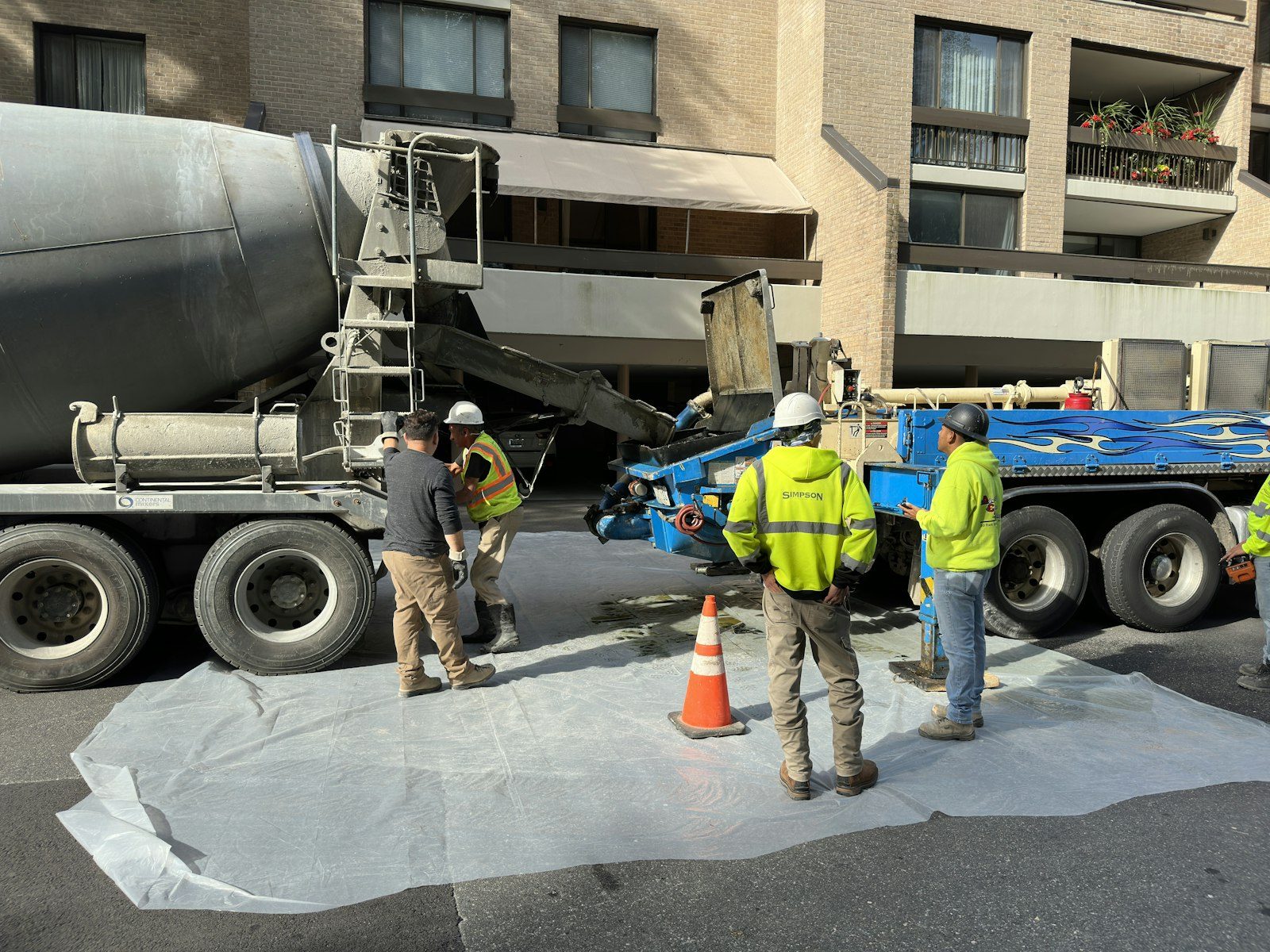
A pad you never think about is a pad somebody thought hard about.
Think about how you actually interact with an equipment pad. The technician who services your standby generator twice a year needs to stand next to it with a toolbox. Somebody has to swap a pool filter cartridge without kneeling in mud. In February, a path has to get shoveled to the heat pump so it isn't sitting in a drift. And every single day, the equipment on top of it needs to be sitting exactly as level as the day it was commissioned.
That's the whole job. Not exciting, but it's a surprising amount of design for a rectangle of concrete. We pour equipment pads across Castle Pines with our structural engineer available whenever the load, the vibration, or the soil makes it worth a second opinion, which happens more often on these hillside lots than people expect.
Manufacturers publish a footprint and a clearance requirement, and most pads get poured to exactly that footprint. Then the first service call happens and the tech is standing in wet dirt with a panel door swinging into the shrubs. We build in working room on the access side, plus enough margin that trimming around the pad doesn't mean crawling.
Placement matters just as much. Away from the drip line of a roof without gutters, out of the path where snow slides off a pitched roof, clear of the spot where the downhill neighbor's runoff crosses your yard. Around BellaMesa and Lagae Ranch, where lots run wooded and sloped, the flattest convenient spot is very often the spot that collects water. We look at where water goes before we look at where the conduit is short.
A pad is rarely just concrete. There's usually a gas line, an electrical feed, a condensate route, a low-voltage control run, or all of them arriving from different directions on different trades' schedules. Anything crossing under or through the pad has to be sleeved and located before we pour, because coring a finished pad to chase a forgotten conduit is a bad afternoon for everybody.
So we do a coordination walk. Where does the feed come from, what size, what depth, sweep or stub-up, does the equipment have a bolt pattern we should set anchors for. Then we mark it, sleeve it, protect the stub-ups during placement, and hand the electrician a pad that's ready instead of a puzzle. That half hour of questions separates a clean install from three trades blaming each other.
| Equipment | The detail that matters most | What we build in |
|---|---|---|
| Condenser or heat pump | Staying level so the compressor and drainage behave | Compacted base, light reinforcement, pad raised above surrounding grade |
| Standby generator | Concentrated weight plus vibration plus a gas and electrical entry | Thicker section, steel mat, sleeved penetrations, anchor pattern set to the frame |
| Pool and spa equipment | Chemical exposure and constant moisture around the slab | Sloped surface for drainage, sealed finish, generous service clearance |
| Propane or storage tank | Even bearing and resistance to settlement over a long footprint | Wider base course, thickened edges, hold-down provisions where required |
| Utility transformer or cabinet | Meeting the utility's own spec, not ours | We build to their drawing, with pull sections and grounding provisions in place |
| Shop compressor or dust collector | Vibration transferring into the building slab | Isolated pad separated from adjacent flatwork, thicker section, isolation joint |
Send us the spec sheet with the footprint and clearances. We'll pour a pad that fits it, not one it barely fits on.
Every tilted condenser pad I get called about has the same story behind it. Poured on loose backfill next to the foundation, no base under it, right where the downspout lands. Three years and it's leaning toward the house.What our crew lead tells homeowners
The pad itself handles cold fine once it's cured. We pour with an air-entrained exterior mix precisely because a low flat slab at 6,450 feet spends its winter absorbing snowmelt in the afternoon and freezing solid overnight, over and over. Air in the mix gives that water somewhere to expand.
What you can do is simple. Shovel the path and around the unit rather than reaching for ice melt, especially during the first winter, because chlorides eat a young surface and rust the hardware sitting on it. Keep snow piles off the equipment. Watch where roof runoff lands once the gutters ice up. And in spring, check whether the pad is still sitting level. Catching a settled corner early keeps it a foam lift instead of a replacement.
Still unsure about something?
Call the crew at (303) 569-4046 and we will talk it through.

Get a free, no-obligation estimate from a crew that knows Colorado soil, Colorado weather, and how to finish concrete that lasts.
Accessibility
Adjust the site to fit how you read and browse. Your choices are saved on this device.