
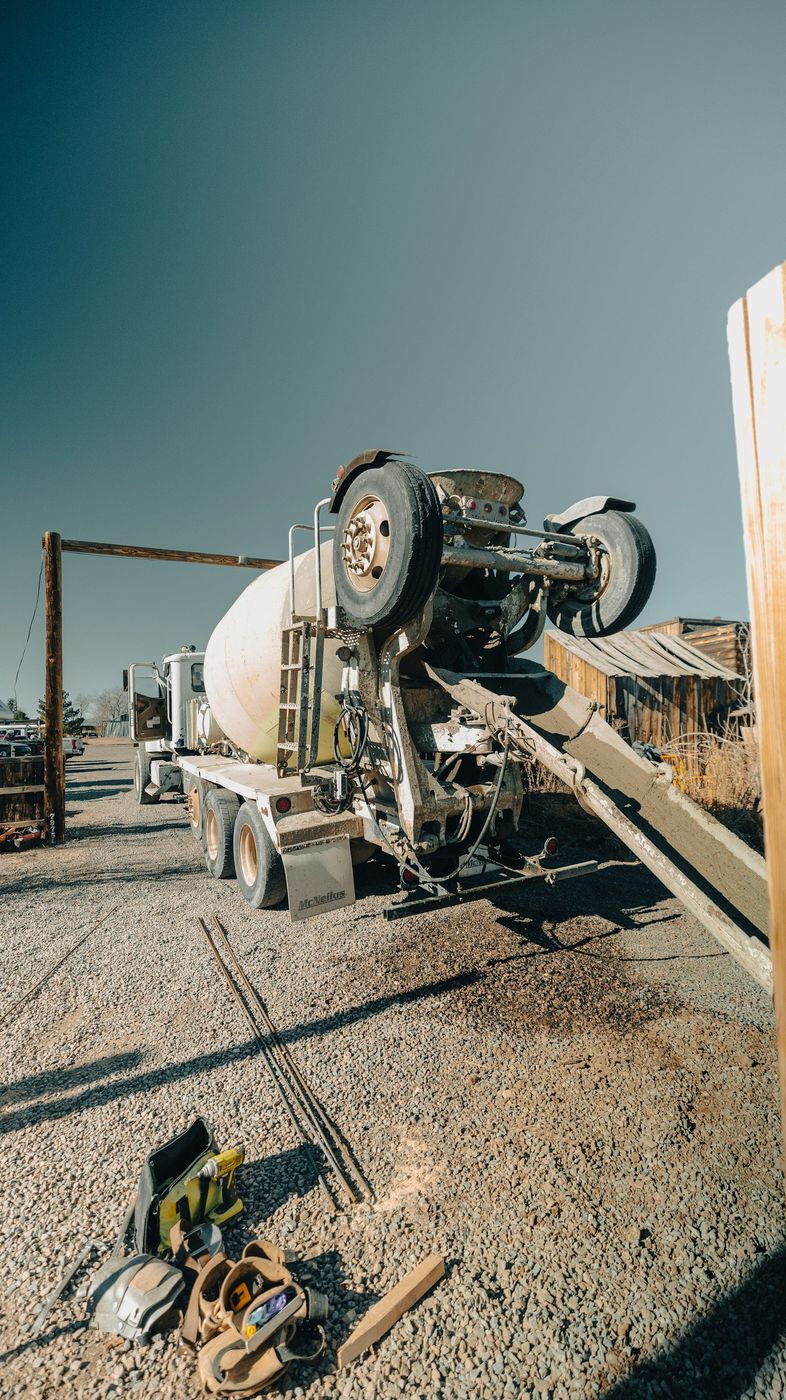
Your drivers grade every dock position on the wall months before the maintenance log catches up.
Stand out in the truck court on a Tuesday morning and you can grade every position on the wall without a tape measure. A trailer at door three is sitting nose-high, which means the concrete under its landing gear has dropped. There is a stain arc where water sheets off a trailer roof and then sits. Door five has a patched square, sunk a half inch below everything around it, with cracks running out of two corners. And every driver bumps the same lip on the way in.
Those are not five problems. They are one problem showing up in five places, and it lives below the slab. Aurora has genuine distribution and industrial space, so we see this pattern constantly: buildings put up for one volume of freight, leased to a tenant running twice that, sitting on backfill nobody ever proved out.
| What you can see | What is happening | Where it ends if nothing changes |
|---|---|---|
| Trailers sitting nose-high at one position | The concrete under the landing gear has settled | The leveler stops reaching and that door comes out of service |
| A puddle that never dries at the base of the wall | Water is running to the building instead of away, into the backfill | The fill keeps consolidating and the whole approach follows it down |
| Cracks fanning out of an old patch | The patch was placed over the void that broke the original slab | Patch and slab fail together and the repair money is gone |
| A broken edge along the pit lip | Forklift wheels hammering an unprotected edge with no steel behind it | Spalling reaches the leveler frame and the pit needs structural repair |
| Rubber scuff arcs concentrated in one lane | Every driver is correcting for the same bad approach geometry | Concentrated wear becomes a rut, then a rocking panel |
| Joint gaps packed with wet fines | Base material is pumping up through the joint under every load | Panels begin rocking, and the base under them is already gone |
Nothing else on a commercial site sees this combination of loads. A parked trailer puts its entire nose weight through two steel landing gear pads, each contacting a few square inches. That is a punching load, not a rolling one, and it lands in the same spot every day. Then a tractor drops, pulls, and jackknifes across the same twenty feet several times a shift, adding torsion the slab was probably never reinforced for.
Inside the pit the loads flip. A forklift crossing the leveler lands its wheels on the pit lip hundreds of times a week, and an unprotected edge with no steel behind it does not survive that. Most edge failures we repair began as a chip somebody ignored for a season.
Water finishes the job. Approaches slope toward the building by design, so all the melt and rain heads for the pit. Up here it freezes overnight and thaws by afternoon, over and over, and whatever soaks into loose backfill carries fines out and leaves a void.
Send photos from the truck court and tell us how many trailers you take a day. We will tell you which positions need concrete and which need grade.
Almost nobody can hand us an empty dock wall, so we work in positions. One or two doors come out at a time, get demoed, prepped, poured, and returned before the next pair closes. Receiving keeps running on the rest, and you know a week ahead which doors you lose and when.
Nights and weekends are normal on distribution property. Cold nights need blankets down before dark and a non-chloride accelerator in the mix, and we would rather move a date than strip protection early to hit a promise. Equipment sets the rest of the schedule: if levelers, bumpers, or bollards are being replaced, those elevations come from the supplier and we pour to them. One meeting up front prevents a week of rework.
Season matters less here than on most exterior work, since the areas are small enough to protect. If your freight calendar has a slow stretch, tell us and we will build around it.
The receiving we work on ranges widely. Service and retail buildings near Southshore, Saddle Rock, and Tallyn's Reach usually have one or two doors behind a suite. Out toward Sterling Hills, Murphy Creek, and Tollgate Crossing we see older walls with a full row of positions.
Still unsure about something?
Call the crew at (303) 569-4046 and we will talk it through.
Get a free, no-obligation estimate from a crew that knows Colorado soil, Colorado weather, and how to finish concrete that lasts.
Accessibility
Adjust the site to fit how you read and browse. Your choices are saved on this device.