
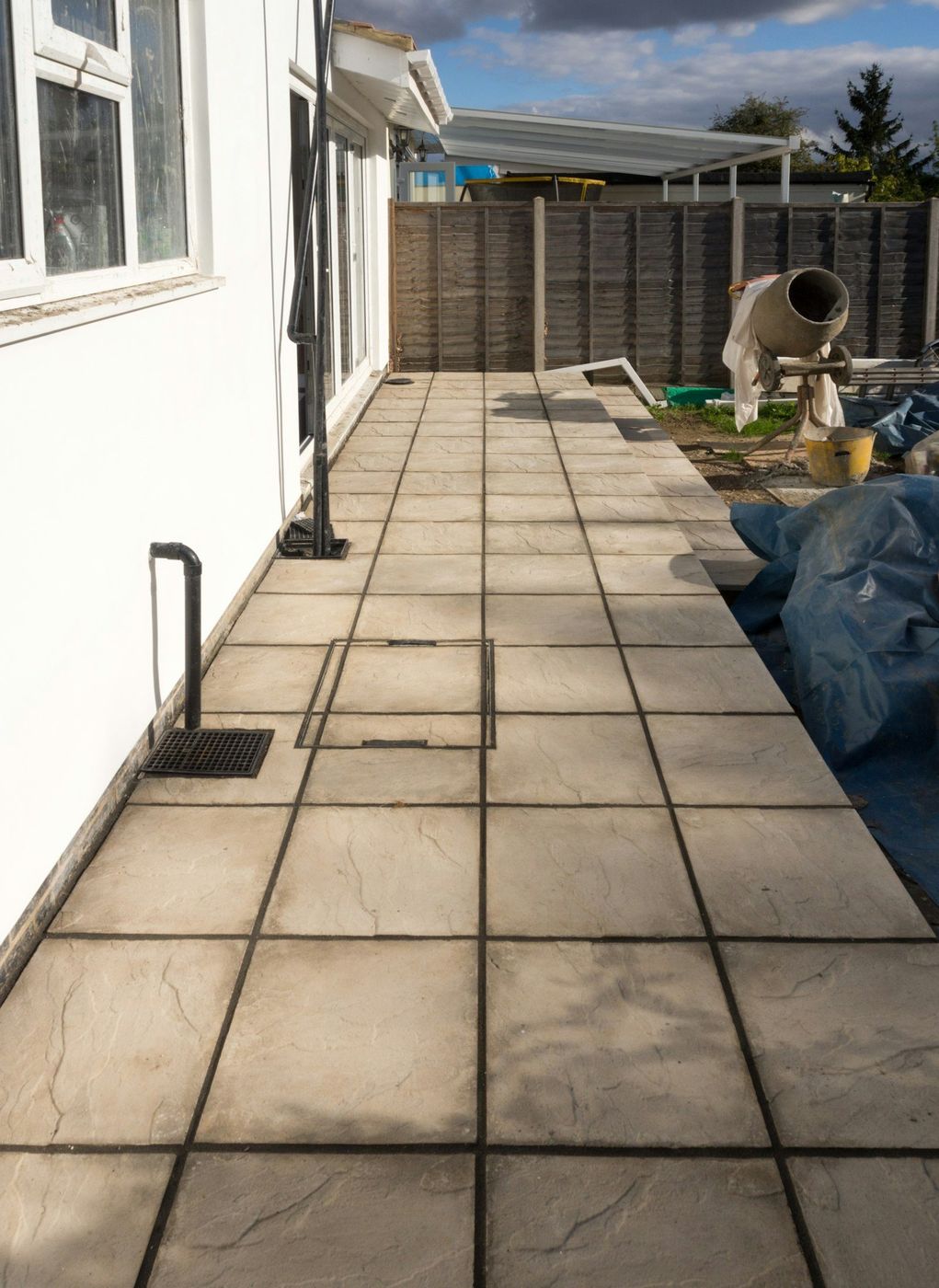
One pour, and about four hours in the middle of it that decide how the surface feels barefoot for twenty years.
A pool deck is the one slab where the customer is standing on it wet, barefoot, and moving fast. That changes everything about the day we place it. The mix, the timing of every tool, the direction of the broom, where the water goes when it leaves. None of that can be added later.
So here's the whole day, start to finish, the way it actually runs on an Arvada backyard. Some of it is the same on any slab. The parts that aren't are the parts worth reading, because they're the ones you'll feel every July.
First question of the day is never about concrete. It's how the material gets from the street to the back yard. On the larger lots toward West Woods and Whisper Creek there's usually a route wide enough for a buggy. On the tighter properties near Olde Town it's a pump line over the roof or down a side yard barely wider than a wheelbarrow, and that gets settled a week out, not at seven in the morning.
Then the pool gets protected. Plywood and plastic across the coping, skimmer throat covered, water surface sheeted wherever we work over it. A wet vac stays plugged in all day.
Last, grade. Every stake and screed line is checked against the coping elevation, because the coping is fixed and the deck has to come to it. Get that wrong and no amount of finishing saves it.
| The pass | When it happens | What it does for bare feet |
|---|---|---|
| Screed | Immediately behind the placing crew | Sets plane and fall. Everything after is texture, not shape. |
| Bull float | Right behind the screed, before bleed water shows | Knocks the ridges down and buries the coarse stone so nothing sharp surfaces |
| Wait | As long as the weather says, sometimes an hour | The single most important step. Working bleed water into the surface is how a deck ends up dusting. |
| Edge and hand-tool the coping line | Once the surface holds a thumbprint | Rounds the edge nobody thinks about until they kick it |
| Broom | Late, in one direction, across the path people walk | This is your traction. Dragged too early it closes up smooth; too late and it tears. |
| Saw the joints | Same day, usually that evening | Puts the cracks where we chose instead of where the slab picks |
Concrete starts at the far edge and moves toward the pool, never the reverse. Nobody walks backward toward open water carrying a screed, and any spillage lands on ground we're about to cover.
Fall gets built in as we go, always away from the coping. Shedding into the pool is the lazy answer and it sends dirt, sunscreen, and whatever the last storm dropped straight to your filter. Water goes to the drains or out to the yard, and on a deck ringed by fence it goes to drains, because there's nowhere else.
Thickness and steel are the boring part and we don't trim them. Four inches over compacted base, rebar chaired up in the slab, and extra attention on the first eighteen inches out from the shell where the excavation got backfilled. That ring is looser than the rest of the yard, and it's exactly where a deck drops if the base work was rushed.
Tell us how the yard is fenced and how wide the narrowest gate is. That decides the plan more than the square footage does. (303) 569-4046.
Cure comes first, and at 5,344 feet it isn't optional. Dry air, hard sun, and wind pull water out of a fresh slab fast, and a deck that dries too quickly grows a weak surface that starts shedding in year two. It stays wet or covered for the first several days whatever the sky is doing.
Swim traffic can start after about a week. Furniture waits the full month, and so does sealer. That sealer choice is what mostly decides how slick a wet deck feels, so we settle it before the pour instead of after.
The season runs late spring through September, and mid-September might be the best stretch of all: warm days, cool nights, low storm risk, full cure before anything freezes. Summer pours are routine if we start early and watch the front build over the foothills. Rain during finishing is the one thing that truly ruins a deck, and we'll move a date rather than risk it.
Still unsure about something?
Call the crew at (303) 569-4046 and we will talk it through.
Get a free, no-obligation estimate from a crew that knows Colorado soil, Colorado weather, and how to finish concrete that lasts.
Accessibility
Adjust the site to fit how you read and browse. Your choices are saved on this device.