
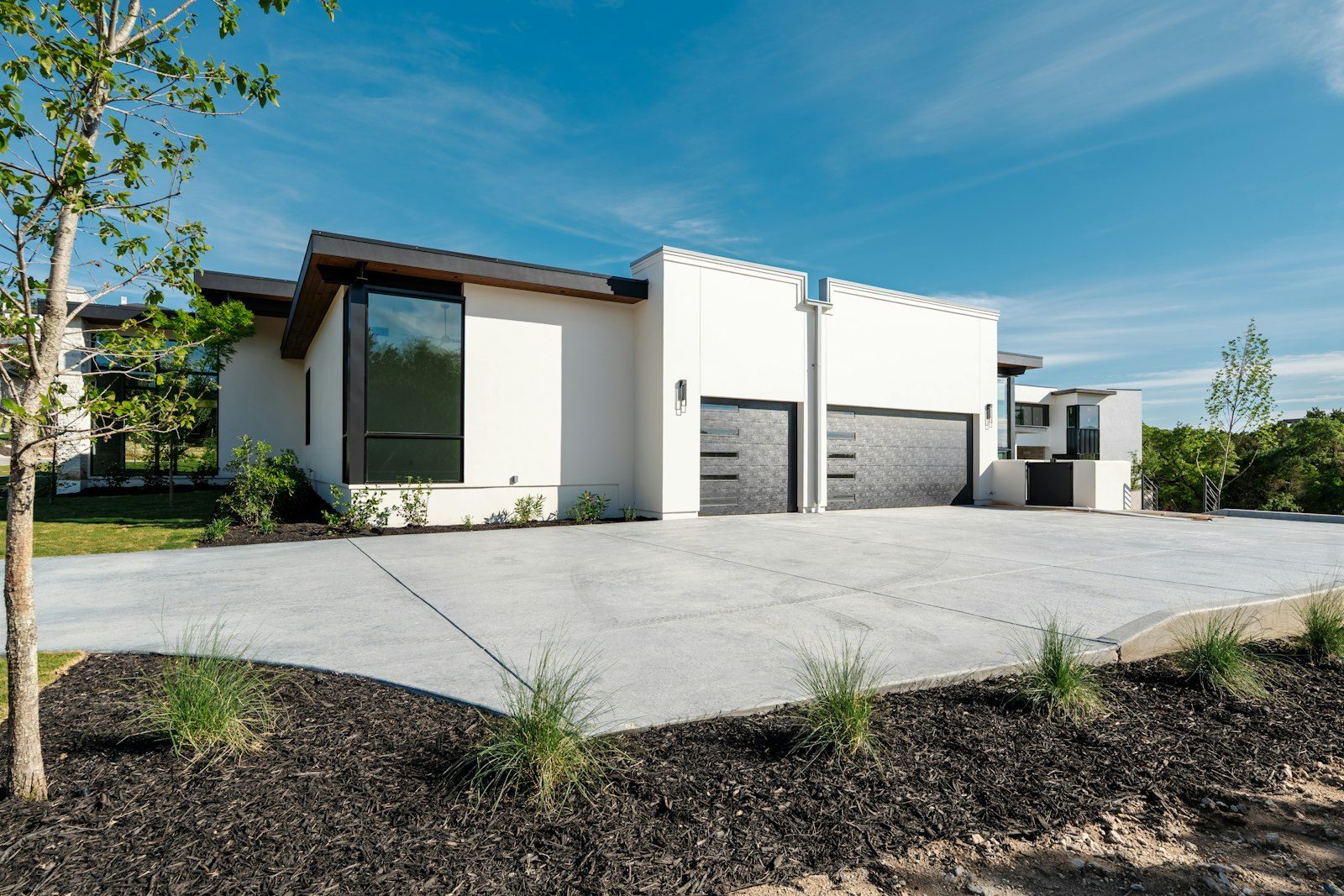
A slab gets poured once and sealed eight or ten times. Those coats decide whether you ever pay for the pour again.
Run the arithmetic on a driveway the way we do. It gets placed one time. Over the next twenty-five or thirty years it gets sealed somewhere between eight and a dozen times, if the owner keeps up with it. Every one of those coats is a small line on a small invoice. Together they're the difference between a slab you replace once and a slab you replace twice.
That's the whole value argument for sealing, and we'd rather make it in years than in adjectives. Nobody looks at a freshly sealed driveway and feels good about the money. The payoff is invisible on purpose: it's the scaling that didn't happen, the joints that didn't ravel, the apron that's still square. We seal new work, old work, patios, walks, and shop floors all over Arvada.
Water is the enemy and everything else is a detail. Concrete is porous. Water gets in, carrying road salt and fertilizer and whatever else was on the surface, and then the temperature crosses freezing and comes back, which happens dozens of times a winter here. Each cycle expands what's in the pores and pushes the paste apart from the inside out. You see it as scaling, as dusting, as an edge losing a grain at a time.
Penetrating sealers, the silanes and siloxanes, soak in and react down inside the concrete. Nothing sits on top, so the look barely changes, traction doesn't change, and a shovel blade has nothing to catch on. That's what goes on driveways, walks, RV pads, and anything that gets cleared hard in winter. It's also what we'd pick if somebody could only afford one surface, because it protects the most square footage per hour of labor.
Film-forming products, mostly acrylics outdoors, sit on the surface, deepen color, and add sheen. That's what a stamped or colored patio needs, since color is worth protecting and worth showing off. The tradeoff is that a film scratches, can get slick when wet, and eventually has to be stripped rather than recoated forever. Indoors, urethanes and epoxies do heavy duty on shop and garage floors where sun isn't a factor. Putting a film-former on a plowed driveway is one of the most expensive mistakes in this trade, because the only way back out of it is stripping the whole thing.
We'll test it, tell you what's there, and put a real interval on it. Free estimate. Call (303) 569-4046.
| Where the slab is | What you see | What it takes to fix at that point |
|---|---|---|
| First few years, never sealed | Nothing at all. Concrete still looks new | One sealer coat. This is the cheapest the problem will ever be |
| Scaling starts, usually at the apron or a door | Thin flakes of surface lifting, sand showing through | Repair the affected area, then seal. Now there's labor beyond the coating |
| Surface gone across whole panels | Aggregate showing everywhere, rough underfoot, constant dusting | Resurfacing or replacement. Sealer has nothing left to protect |
| Base saturated and panels moving | Settled sections, rocking, cracks with one side higher | Full tear-out and repour. A surface problem became a structural one |
Square footage is the smallest part of it. What moves a sealing quote is condition: how much cleaning and degreasing the slab needs, whether an old coating has to come off, and how much hand detail there is around steps, edges, and joints. A clean drive out around Candelas or Whisper Creek is close to a straight coating job. A patio in one of the older neighborhoods carrying thirty years of grill grease and a failing film in the traffic path is mostly labor.
Timing comes down to a dry slab, mild temperatures, and dry weather on both sides of the work. Our best windows are late spring and again from late August into October, and fall is the favorite because the slab goes into winter protected. We won't seal during a February warm spell no matter how pleasant the afternoon feels, since the concrete is still carrying snowmelt and the product won't cure at those overnight temperatures. New concrete waits 28 days at minimum, longer for some products and longer still if it went down in cold weather. And on any slab in its first winter, no deicers, sealed or not.
Still unsure about something?
Call the crew at (303) 569-4046 and we will talk it through.
Get a free, no-obligation estimate from a crew that knows Colorado soil, Colorado weather, and how to finish concrete that lasts.
Accessibility
Adjust the site to fit how you read and browse. Your choices are saved on this device.