
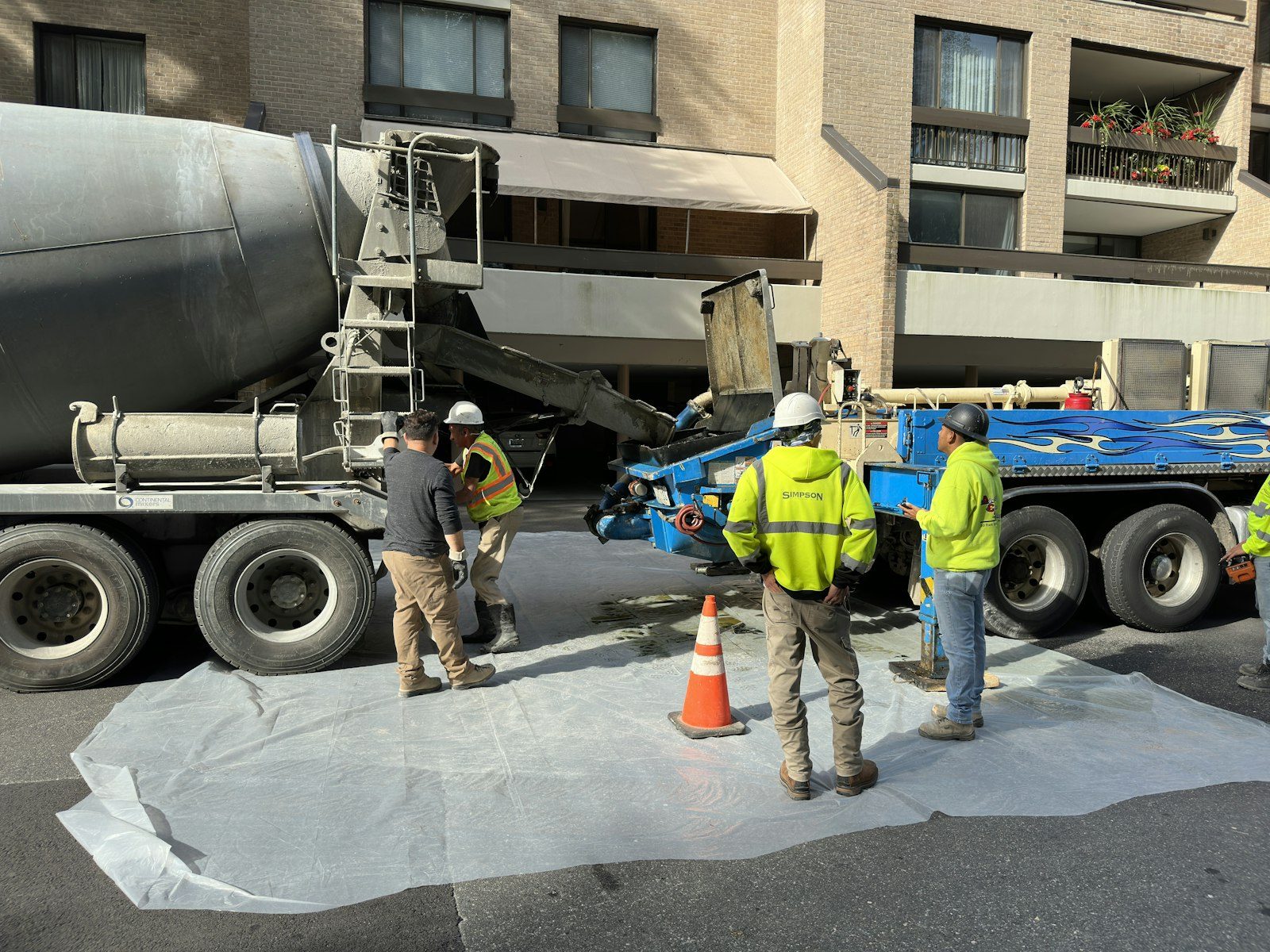
Standalone slab, driveway extension, or one pad that does both jobs. Pick that first and the rest of the design follows.
The question people call with is what size. The question that actually matters is whether the court should be its own slab at all, because on a lot of Arvada lots the cheapest good answer is a wider, longer driveway with a hoop at the end of it.
We'd rather have that conversation before anybody measures a key. A court is a big flat slab with unusually strict requirements, and there are three or four ways to get one onto a property. Some of them are half the price of the others and play nearly as well.
First, where it goes. The bigger lots in Candelas and Leyden Rock usually have a back-yard spot with room around the perimeter, which is ideal. Near Olde Town the yards are small enough that a half court eats everything green, while the drive out front is already the flattest, widest concrete on the property. West Woods lots tend to slope, and slope turns a simple pour into an earthwork project.
Second, how much surface. Chasing a regulation footprint in a back yard is how families end up with a court nobody uses because it took the lawn. Most play happens around the key.
Third, the surface, which people obsess over first and should consider last. Bare concrete plays fine. Acrylic sport coating plays better and looks the part. Neither one saves a slab that isn't flat, so we'd rather your money go into the concrete and let color wait a season.
| The build | What it gains you | What you give up |
|---|---|---|
| Dedicated back-yard court | Real playing surface, clean joint layout, room behind the baseline | The most concrete, the most yard, usually the most site work |
| Widened, lengthened driveway | Ground is already flat, one pour, and it earns its keep year round | Cars in the way, a hoop near the street, neighbors closer than you'd like |
| Side-yard sport pad | Uses ground that grows nothing anyway | Narrow, so it plays as a shooting area, not a game |
| Court that doubles as parking | One slab, two uses, easy to justify | Thicker for vehicle loads, and tire marks on any coating |
| Slab now, coating later | Spreads the cost and lets the concrete cure first | Two mobilizations and a season of gray |
This is what separates a court from a patio. A patio can carry a little roll and nobody cares. A court can't, because the ball reports every dip. So we screed the whole thing as a single plane tipped one direction, about one percent, which sheds water without anybody feeling it underfoot.
Never a crown. Never two planes meeting in the middle. A ridge down the center is the most common mistake we get called out to look at, and grinding doesn't fix it.
Joints get drawn on paper before forms go down. A slab this size has to be jointed or it cracks where it likes, so the pattern falls outside the key and away from the free throw line, running with play instead of across it. Sawed the same day, tight and clean. And there's steel in it, chaired rebar through the whole slab, because a court is one of the few residential pours where a stray crack ruins the function and not just the look.
Send a rough sketch of the yard with the fence lines on it. We'll tell you what fits and what it costs in grass. (303) 569-4046.
Point the hoop north or south if the lot allows. An east or west backboard puts somebody shooting into a low sun for part of every evening, and that's the difference between a court used after dinner and one that isn't. Where geometry forces the issue, we'd move the whole slab a few feet rather than accept the glare.
Pour season runs late April into October, and September is the best of it: warm enough for a clean finish, cool enough that the surface isn't setting under our feet, with time to cure before hard freezes. Summer works with an early start and an eye on the storms building over the foothills, since rain during finishing strips the surface off a slab this size fast.
Coatings want their own window: cured concrete and warm days. A September slab usually gets color the following spring. Play on the gray all winter, shovel rather than salt, and keep deicer off it entirely the first year.
Still unsure about something?
Call the crew at (303) 569-4046 and we will talk it through.
Get a free, no-obligation estimate from a crew that knows Colorado soil, Colorado weather, and how to finish concrete that lasts.
Accessibility
Adjust the site to fit how you read and browse. Your choices are saved on this device.