
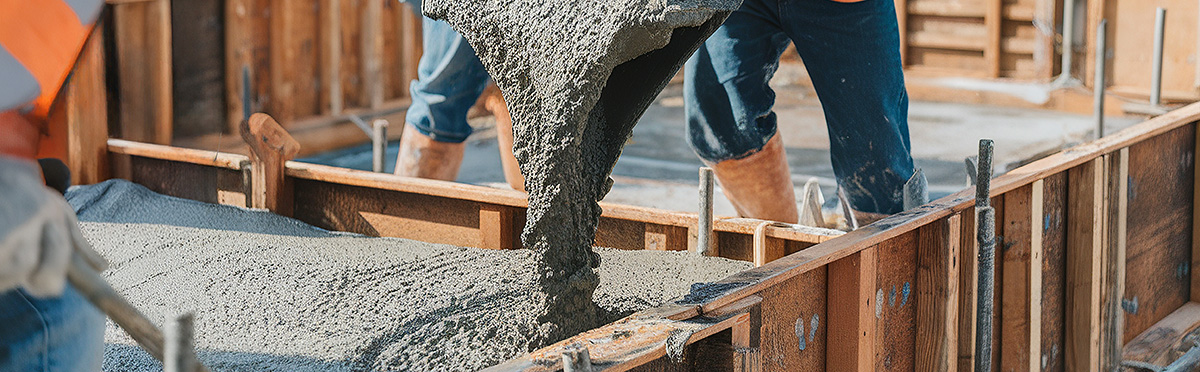
Approaches and dock slabs built for truck traffic.
A loading dock is the hardest-worked piece of concrete on most commercial properties. Trucks back into the same approach all day, drop their landing gear on the same square of slab, and grind their drive tires through tight turns loaded heavy. Add box trucks, semis, and the occasional forklift crossing the threshold, and you have traffic that no ordinary parking pour can survive. We build dock approaches and loading zones for that exact punishment, with the thickness, the steel, and the base to carry it for years instead of months.
On the Front Range, the load is only half the story. The same slabs that take truck weight also sit through hard freeze-thaw swings, road salt tracked in from the street, and expansive clay that wants to move underneath them. A dock built without air-entrained concrete, a compacted base, and real drainage will spall, crack, and settle fast. We pour loading areas that handle both the trucks and the Colorado weather, so your shipping operation is not shut down by a failed slab in February.
We fix the base and drainage behind the old failures so the new slabs do not crack the same way. For loading docks & zones, that local knowledge is exactly what protects your investment. We plan the base, drainage, reinforcement, and finish around the conditions on your Wheat Ridge property, not a generic detail.
We serve every part of Wheat Ridge and the surrounding area, including Applewood, Paramount Heights, Hopkins. Wherever you are in Jefferson County, the crew shows up with the same standard.
At roughly 5,413 feet, Wheat Ridge gets intense high-altitude sun and a freeze and thaw cycle that is hard on any concrete poured without care. For loading docks, that means air-entrained mixes, deliberate curing, control joints cut on time, and a base prepared for the expansive clay under your property. It is the difference between work that holds for decades and work that starts failing by the first or second spring.
A car spreads its weight across four tires and rolls through. A loaded semi puts tens of thousands of pounds on a few contact points, then drops a steel landing gear leg onto the slab while it sits parked. That is a concentrated, repeated punch that a four-inch parking pour cannot take. We pour dock approaches and loading zones thicker than standard flatwork and tie them together with rebar, not just wire mesh, so the slab acts as one structural unit. The reinforcement spreads the load, holds the slab flat under turning tires, and keeps a crack from one wheel path from spreading across the whole pad. Thickness and steel are chosen to match the trucks you actually run, not a generic number.
The strongest slab in the world will still fail if the dirt under it moves. That is the real risk on Front Range clay, which swells when wet and shrinks when dry. Before any concrete goes down, we excavate to depth, bring in and compact a structural base in lifts, and grade it so water drains away instead of pooling against the slab. Loading zones see a lot of water: rain, snowmelt, wash-down, and whatever drips off the trucks. We pitch the surface to move that water to where you want it and, where the layout calls for it, set trench drains across the approach so runoff never sits on the slab or runs back toward the dock door. Good base and good drainage are what keep the pad from settling and heaving.
A loading dock rarely stands alone. The concrete approach has to meet existing asphalt, a public street, or a ramp down to a depressed dock, and that joint is where a lot of docks come apart. We detail the transition so the two surfaces meet flush, with the concrete edge thickened and reinforced to take the impact of a truck rolling across it. Where the design calls for it, we form and set trench drains right at the transition or along the staging zone, cast into the pour so the frames sit tight and the grates carry traffic without rattling loose. Done right, the transition gives a smooth pass for trucks and keeps water from undercutting either surface. Done wrong, it ravels and potholes within a season.
Here is the straight answer to the concern every facility manager has: will it crack. All concrete moves, and on a slab taking truck loads through Colorado winters, the goal is not zero cracks, it is controlled ones. We place sawcut control joints on a tight, planned grid so the slab cracks where we tell it to, in a clean straight line, instead of wandering across your dock. The bigger enemy is spalling, where the top surface flakes off under freeze-thaw and road salt. We fight that with air-entrained mixes that give the water somewhere to expand, real curing so the surface reaches strength before traffic hits it, and sealing to keep salt and water out. We will not promise a crack-free slab, because nobody honest can. We will build one that holds its line and its surface for the long haul.
Every Wheat Ridge job starts with a free, written estimate and a structural engineer on staff for the work that needs one. Licensed, bonded, and insured, with finishes from a clean broom texture to stamped, colored, and sealed.
You always know what is happening and what it costs before we mix a single yard. Here is the path from first call to final walkthrough.
We visit the site, measure, check drainage and soil, and hand you a clear written quote. No charge, no pressure.
We set the grade, thickness, reinforcement, and finish. Structural work gets engineered and permitted.
Forms, rebar, and a clean pour. We screed, float, and finish to the texture you picked, then cut control joints.
You can walk it in 24 to 48 hours. We walk the job with you and explain how to care for it through the first winter.
Still unsure about something?
Call the crew at (303) 569-4046 and we will talk it through.

Get a free, no-obligation estimate from a crew that knows Colorado soil, Colorado weather, and how to finish concrete that lasts.
Accessibility
Adjust the site to fit how you read and browse. Your choices are saved on this device.