
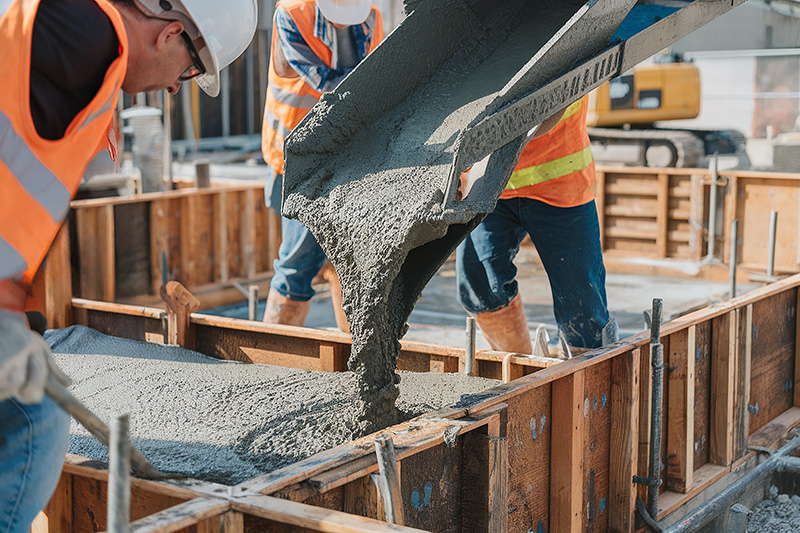
Clean cut lines that turn a slab into a pattern.
Saw-cut and scored patterns take a plain gray slab and turn it into something that looks designed. We cut clean lines into the surface to break it up into large tiles, diamonds, ashlar blocks, or a simple bordered field. Paired with color and a good sealer, scoring gives concrete a custom look that reads like stone or tile at a fraction of the cost, and without the joints and grout lines that collect dirt and weeds.
The part most people miss is that these cuts do real work. The crisp lines you see as a pattern can double as control joints, the planned weak points that tell a slab where to crack instead of letting it crack wherever it wants. On the Front Range, where expansive clay and the freeze-thaw cycle put constant stress on flatwork, that matters. A scored slab that is laid out with jointing in mind looks better and holds up better than one that was only cut for show.
Hilly, treed terrain makes grading and drainage central to every job out here, and we plan for both. For saw-cut & score patterns, that local knowledge is exactly what protects your investment. We plan the base, drainage, reinforcement, and finish around the conditions on your Sedalia property, not a generic detail.
We serve every part of Sedalia and the surrounding area, including Bear Canyon, Indian Creek, Daniels Park area. Wherever you are in Douglas County, the crew shows up with the same standard.
At roughly 5,860 feet, Sedalia gets intense high-altitude sun and a freeze and thaw cycle that is hard on any concrete poured without care. For saw-cut patterns, that means air-entrained mixes, deliberate curing, control joints cut on time, and a base prepared for the expansive clay under your property. It is the difference between work that holds for decades and work that starts failing by the first or second spring.
We score concrete two ways, and they are not the same job. On a fresh pour we can tool joints while the concrete is still green or come back with a saw once it has set, laying the pattern out before the slab has a chance to crack on its own. That is the cleanest result because the cuts and the control joints are one and the same. On an existing slab we work with what is already there. We map any cracks and joints that already exist, then design the score pattern so the lines fall where they help rather than fighting the slab. Cutting an old slab kicks up a lot of dust, so we run wet saws or dust collection to keep your property clean.
A good pattern starts with measuring the space and finding its real center and its sightlines, not just cutting evenly spaced lines and hoping. We chalk the layout, check it against the doorways, edges, and the way you walk across the surface, and adjust before any blade touches concrete. Tile and diamond grids get sized so you are not left with a sliver of a cut tile at one edge. Borders get set in from the perimeter a consistent distance. We also plan the depth and spacing of cuts that need to act as control joints, since a joint that is too shallow or too far apart will not do its job. Once the lines are right, we cut them crisp and uniform so the finished pattern looks intentional from any angle.
This is the honest concern with scoring, and it is fair. A saw cut is a groove in the surface, and people worry those grooves will spall, widen, or collect water that freezes and breaks the edges apart. Here is the straight answer. When the cuts are placed to function as control joints and sealed properly, the slab cracks along the lines you chose, which is exactly what you want, and the joint stays tight. Where scoring gets into trouble is when the lines are purely cosmetic and ignore where the slab actually wants to move. Then you can get random cracking that crosses your pattern. We avoid that by tying the layout to the jointing plan from the start, cutting to the right depth, and sealing the cuts so water and salt cannot work into them through our freeze and thaw winters. Done that way, the lines hold.
Scoring on its own is subtle. The pattern really comes alive when we combine the cuts with color and a sealer. Integral color or stain gives the field its tone, and the cut lines read as crisp shadow lines against it. We can also work color into the cuts themselves or use a contrasting band along a scored border so the pattern stands out. A sealer is not optional here, it is what protects the cut edges, deepens the color, and keeps the whole surface shedding water and resisting the UV that fades and chalks finishes at our altitude. We talk through the look you want up front so the color, the pattern, and the sheen of the sealer all work together instead of being three separate decisions.
Every Sedalia job starts with a free, written estimate and a structural engineer on staff for the work that needs one. Licensed, bonded, and insured, with finishes from a clean broom texture to stamped, colored, and sealed.
You always know what is happening and what it costs before we mix a single yard. Here is the path from first call to final walkthrough.
We visit the site, measure, check drainage and soil, and hand you a clear written quote. No charge, no pressure.
We set the grade, thickness, reinforcement, and finish. Structural work gets engineered and permitted.
Forms, rebar, and a clean pour. We screed, float, and finish to the texture you picked, then cut control joints.
You can walk it in 24 to 48 hours. We walk the job with you and explain how to care for it through the first winter.
Still unsure about something?
Call the crew at (303) 569-4046 and we will talk it through.

Get a free, no-obligation estimate from a crew that knows Colorado soil, Colorado weather, and how to finish concrete that lasts.
Accessibility
Adjust the site to fit how you read and browse. Your choices are saved on this device.