
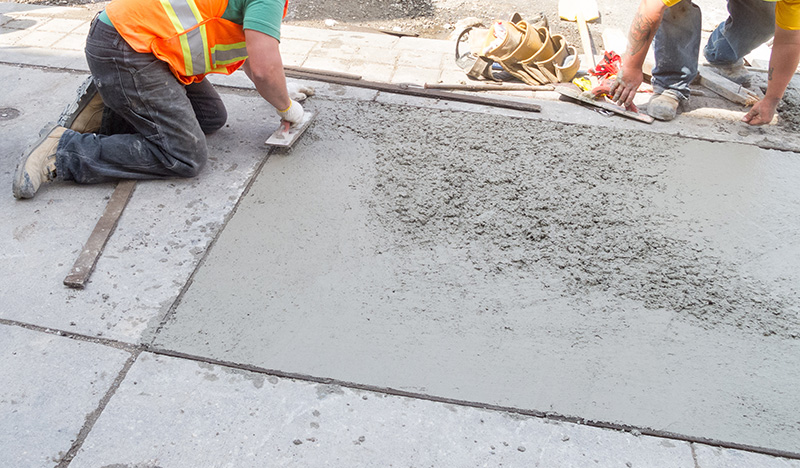
Stabilize cracks and movement before they spread.
A crack in your foundation gets your attention, but the crack is the symptom, not the disease. Something moved that wall or that slab, and until you know what, a patch is just cosmetics that will fail again. Go Denver Concrete approaches foundation repair the way it should be approached: figure out what is driving the movement first, then fix it so it actually stops. We look at the soil, the water around the structure, and the load on the foundation, because on the Front Range those three things cause most of the trouble.
This matters more here than in most parts of the country. Our expansive clay swells when it gets wet and shrinks when it dries out, and it can lift one corner of a house while the rest stays put. Add the freeze and thaw cycle and water that has nowhere good to go, and a foundation that was fine for years can start to move. We are licensed, bonded, and insured, with a structural engineer on staff for the jobs that need a real diagnosis and a stamped fix, not a guess.
Steep, rocky ground makes grading and drainage the heart of the job. We plan both before we form. For foundation repair, that local knowledge is exactly what protects your investment. We plan the base, drainage, reinforcement, and finish around the conditions on your Morrison property, not a generic detail.
We serve every part of Morrison and the surrounding area, including Willow Springs, Friendly Hills, Red Rocks area. Wherever you are in Jefferson County, the crew shows up with the same standard.
At roughly 5,764 feet, Morrison gets intense high-altitude sun and a freeze and thaw cycle that is hard on any concrete poured without care. For foundation repair, that means air-entrained mixes, deliberate curing, control joints cut on time, and a base prepared for the expansive clay under your property. It is the difference between work that holds for decades and work that starts failing by the first or second spring.
Not all cracks mean the same thing. A thin, vertical hairline in a poured wall is often just shrinkage from curing, and it may never need more than a seal to keep water out. A stair-step crack in block, a horizontal crack with a bulge, or a diagonal crack that runs from a corner is a different story, because those point to soil pressure or settlement that is still working on the structure. We measure crack width, check whether it is wider at the top or the bottom, and look for displacement where one side has moved past the other. We also check doors and windows that stick and floors that slope, since those tell us how far the movement has traveled. The reading drives the repair, not the other way around.
Most settlement and heave we find on the Front Range traces back to water and the clay it sits in. When downspouts dump next to the wall, when grade slopes toward the house, or when a sprinkler line soaks one side, that clay swells and pushes. When it dries hard in a drought summer, it shrinks and pulls support out from under a footing. Either way the foundation moves. That is why our repair so often starts outside the wall. We correct grading so water runs away from the structure, extend or reroute downspouts, and address drainage that is feeding the soil. Fix the crack without fixing the water and you are signing up to do it again. We tell you that up front because it is the truth of how these failures work here.
The repair itself depends on what we found. For cracks that are stable and mainly a water problem, we clean and seal them, or inject epoxy or polyurethane to fill the crack all the way through and lock it. Epoxy bonds the concrete back together with real structural strength. Polyurethane stays flexible and is better at stopping active water. For movement that is still happening, sealing alone is not enough, and that is where the engineering comes in. We assess settlement, recommend the right stabilization approach for the soil and the load, and document it so the fix holds up to inspection. When a permit is required, we pull it and manage it. The goal is always the same: stop the cause, then close the crack.
This is the honest worry, and it is a fair one. On expansive clay, a repair that ignores why the foundation moved really can move again, and we have seen plenty of patch-and-pray jobs come back. That is exactly why we will not lead with caulk. We pin down the cause first, and most of the time the cure includes managing the water and the soil around the structure, not just the concrete. When the movement points to deeper settlement, our structural engineer is involved so the recommendation matches your actual soil and load instead of a one-size guess. We will also tell you plainly when a crack is cosmetic and stable, so you are not paying to fix something that was never going to spread. No invented guarantees here, just a repair built to address the cause so the problem stops.
Every Morrison job starts with a free, written estimate and a structural engineer on staff for the work that needs one. Licensed, bonded, and insured, with finishes from a clean broom texture to stamped, colored, and sealed.
You always know what is happening and what it costs before we mix a single yard. Here is the path from first call to final walkthrough.
We visit the site, measure, check drainage and soil, and hand you a clear written quote. No charge, no pressure.
We set the grade, thickness, reinforcement, and finish. Structural work gets engineered and permitted.
Forms, rebar, and a clean pour. We screed, float, and finish to the texture you picked, then cut control joints.
You can walk it in 24 to 48 hours. We walk the job with you and explain how to care for it through the first winter.
Still unsure about something?
Call the crew at (303) 569-4046 and we will talk it through.

Get a free, no-obligation estimate from a crew that knows Colorado soil, Colorado weather, and how to finish concrete that lasts.
Accessibility
Adjust the site to fit how you read and browse. Your choices are saved on this device.