
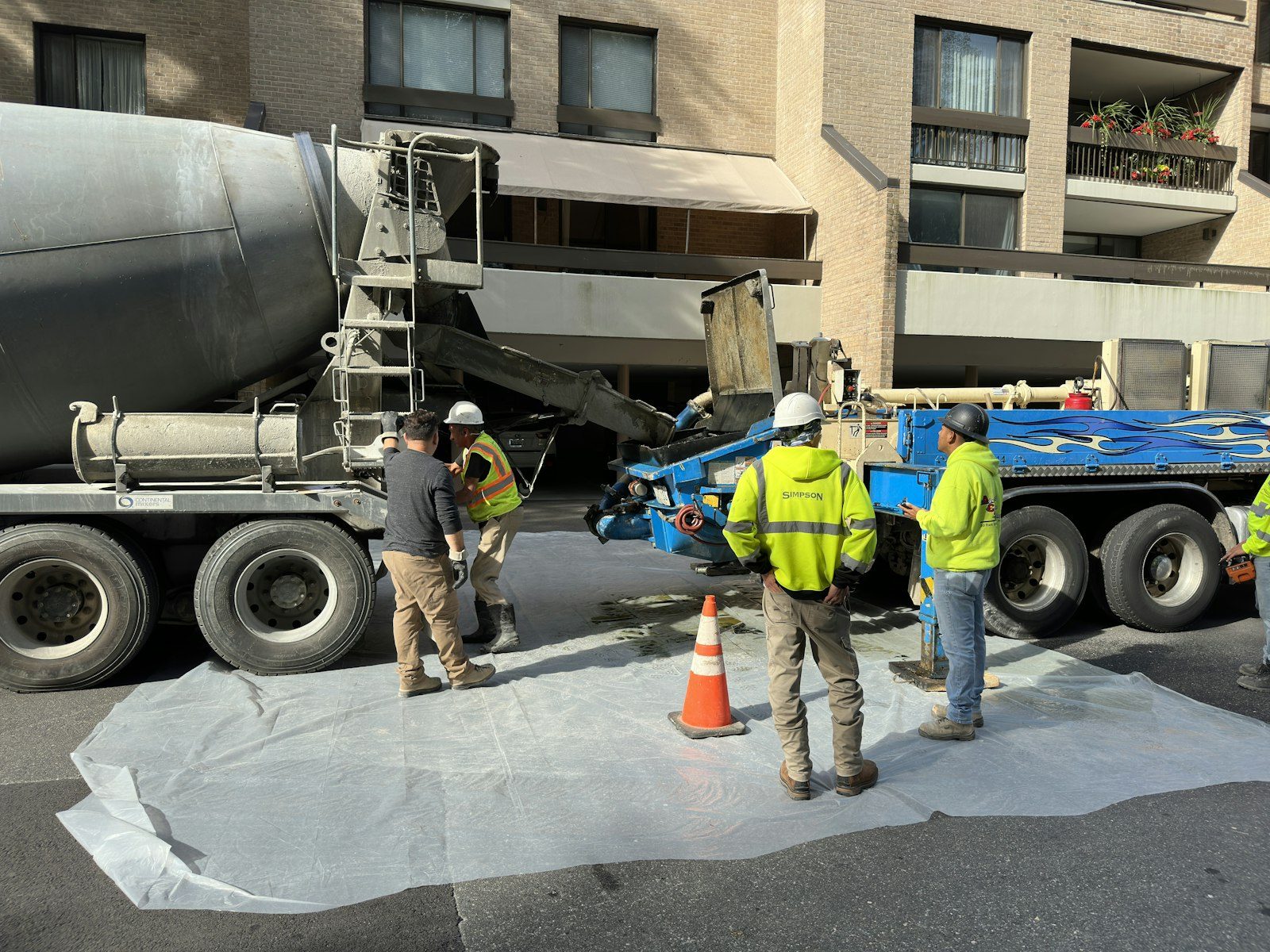
A commercial pour is a logistics problem wearing a concrete costume.
Concrete arrives on a schedule you don't control. The plant loads on a rotation, the pump has another job at two, and finishers can only chase so much surface at once. So a commercial foundation pour is mostly a timing exercise, and everything we do in the six weeks beforehand exists to make one morning go quietly.
We pour footings, walls, grade beams, and floor slabs for buildings around Lone Tree: offices, medical and retail shells, service buildings, and small warehouse space, from the RidgeGate side of town to the everyday commercial properties that serve Heritage Hills, Carriage Club, and Fairways. Different tenants, same discipline. What follows is a pour day from the inside, start to finish, so you know what you're buying and which parts land on your side of the fence.
Long before a truck rolls, the geotech report gets read line by line and the foundation design gets built to answer it. Bearing depth. Swell pressure. Whether the floor sits on grade or gets structural support. Our engineer works that out with the design team, and then submittals go around: mix designs, steel shop drawings, embed layouts, the testing lab's scope.
Then layout. Anchor bolts and embed plates on a commercial building are not approximate. The steel erector shows up with columns fabricated to a drawing, and a bolt pattern that's off by a half inch turns into a field weld and a change order. So we set templates, we shoot the layout twice, and we get the erector's own numbers before the pour rather than after. That single habit has saved more schedule than any piece of equipment we own.
| Time | What's happening | What it protects |
|---|---|---|
| Before sunrise | Final grade check, form walk, pump setup and priming | Catches the mistake that's still free to fix |
| First hour | Lead truck tested for slump, air, and temperature | Keeps a bad load out of your building |
| Morning | Placing and vibrating in lifts, keeping the face live | Consolidation, no cold joints, no honeycomb |
| Late morning | Screed, bull float, then hands off while it sets | Surface strength, since working bleed water ruins it |
| Early afternoon | Power float, trowel passes, finish to the specified tolerance | Flatness that a forklift will notice for twenty years |
| Same day | Saw cutting joints on the clock, not the calendar | Puts the cracks where we chose instead of where it likes |
| Evening | Cure applied, blankets or water as weather dictates | Strength gain and a surface that won't dust |
The finish window is set by the concrete, not by the crew. Once bleed water rises and then leaves, there's a stretch of maybe an hour where the surface takes a trowel properly. Too early and you seal water into the top. Too late and you're fighting concrete that's already made up its mind. On a big slab that means staffing for the whole pour, not the average of it.
Consolidation matters just as much and gets far less respect. A vibrator run properly through wall and grade beam pours drives air out and gets paste around every bar. Run it badly and you get honeycomb behind the form, which you discover on strip day with an inspector standing next to you.
Send the foundation plan and the geotech report. We'll walk the schedule and the pour sequence with you before you commit to a date.
Winter changes the method, not the standard. Heated mix water, non-chloride accelerators, ground thaw before excavation, insulated blankets over fresh work, and temperature logs kept for the inspector. Cold pours run slower and cost more, and we say that out loud during bidding instead of discovering it in February. April through October is easier and cheaper. If your schedule allows it, take it.
Occupied buildings are their own puzzle. Replacing a section of failed slab inside a working tenant space means sawcut boundaries, dust control, and a plan for where the forklift goes on Tuesday. We phase that work in bays, pour on nights or weekends when the operation demands it, and hand back a walkable surface before the doors open. Nobody loses a day of business because we needed a longer pour.
Still unsure about something?
Call the crew at (303) 569-4046 and we will talk it through.
Get a free, no-obligation estimate from a crew that knows Colorado soil, Colorado weather, and how to finish concrete that lasts.
Accessibility
Adjust the site to fit how you read and browse. Your choices are saved on this device.