
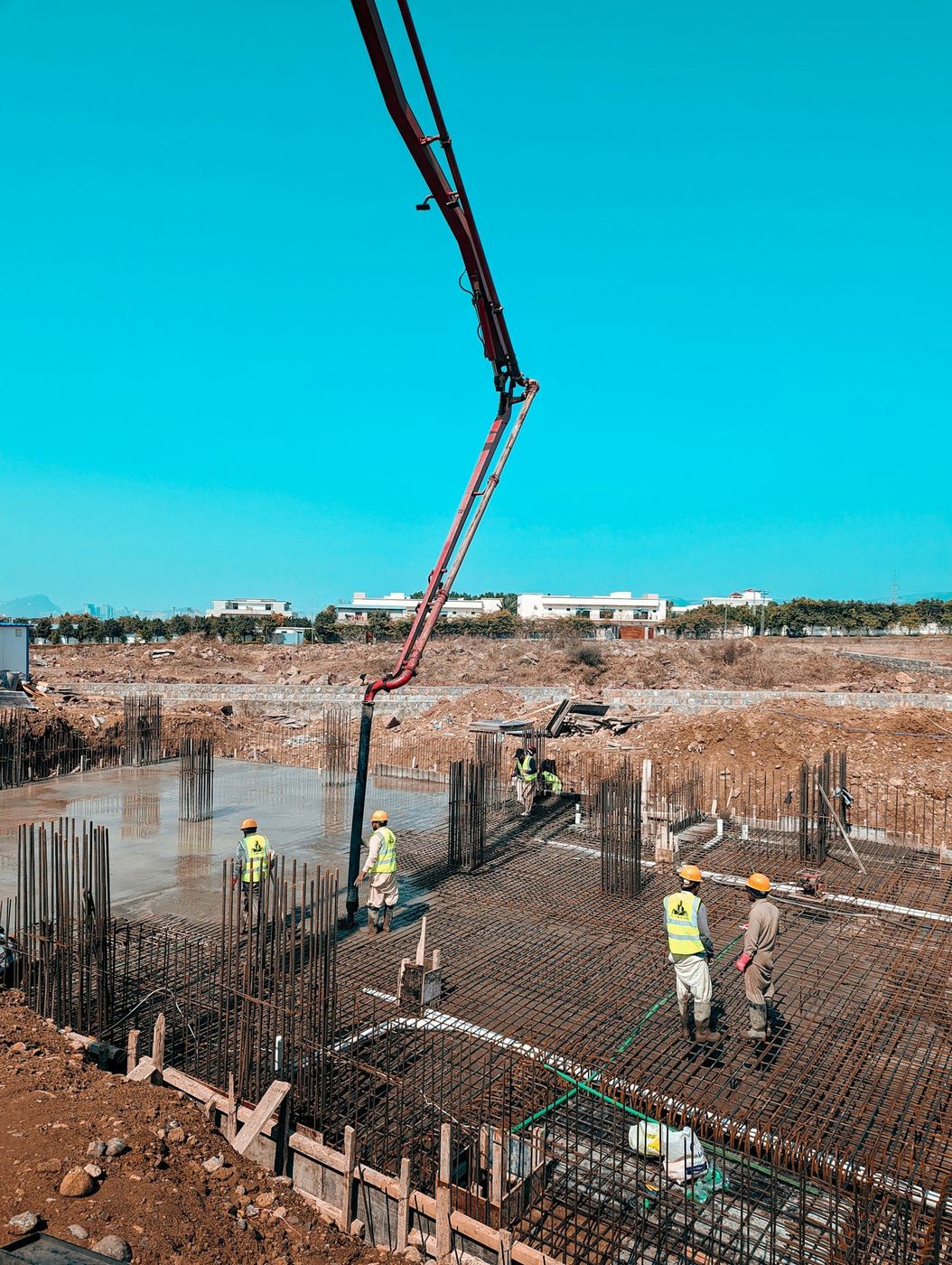
A sand and cement slurry pumped under a dropped panel, on a season that closes earlier than most people plan for.
There's a date we watch every autumn, and it isn't on any calendar you'd buy. It's the night the subgrade under your flatwork stops thawing out by lunch. After that, pumping slurry into ground that stays locked up is a waste of your money and our morning, so slab lifting in Littleton has a closing bell somewhere in late fall and a reopening in March.
People find that out the hard way. A walk sinks all summer, nobody minds, then somebody trips on it the week before company arrives in December. By then we're booking April. If you've been looking at a dipped panel since July, the useful move is calling in September, not the day the first real cold front comes through.
Slurry is wet cement and sand. It has to flow into a void, spread, and then set, and none of that behaves the way it should when the dirt around it is frozen. Frozen ground also lies to you. It reads solid under the pump, gives a beautiful lift, then thaws in April and drops the panel right back where it started.
So we run the pump from the spring thaw through the last stretch of workable fall weather, and we schedule around soil temperature rather than air temperature. A fifty degree afternoon following four nights in the teens is not a pumping day. Late spring and early fall are the good ones: soft ground, long working light, cure that finishes before the overnight low matters.
Spring is also when settlement becomes obvious. Snowmelt saturates the fill under a slab, the fines wash out, and the panel finds its new elevation. That's why the phone rings in March about a walk that looked fine in November.
| What we do | What it means for you | |
|---|---|---|
| Drilling | Cores at roughly an inch and five eighths through the slab | You'll see the patched circles up close, less so from the street |
| Hole pattern | A grid across the panel, tightened where the void is deepest | More holes on a long apron than on a single walk square |
| The material | Sand, cement, and water, pumped as a heavy slurry | It fills and packs the void as much as it lifts the concrete |
| Soil demand | The ground has to carry the added weight of the fill | Very soft or deep fill is a poor fit and we say so before drilling |
| Cure | The slurry sets under the slab over the next day | Walk it that evening, drive it the following day |
| Afterward | Cores patched with a color-matched mix, joints checked | The panel is back at grade and the joint sheds water again |
Location tells you a lot before we ever probe the base. Up along the slope in Ken Caryl the problem is usually moving water. Ground sheds toward the house from above, and whatever the grading was supposed to do, some of that flow ends up traveling along the underside of a drive or a patio instead of around it. That water carries fine material downhill with it, hole by hole, until a panel has nothing left holding its uphill corner.
Out on the flats around Columbine and Southbridge the story is older and quieter. Utility trenches were backfilled decades ago, the slab went over the top, and that backfill has been consolidating ever since. Highland Walk and The Hills at Piney Creek show a third pattern: newer construction, engineered pads, and settlement concentrated right where the deepest fill sits, often at a garage apron or the far corner of a patio.
None of it is random. Find the water and the fill, and you've found the panel that's going to move next.
We'll probe the base, tell you whether a slurry lift is the right call, and get you on the schedule before the ground closes for the year.
Still unsure about something?
Call the crew at (303) 569-4046 and we will talk it through.

Get a free, no-obligation estimate from a crew that knows Colorado soil, Colorado weather, and how to finish concrete that lasts.
Accessibility
Adjust the site to fit how you read and browse. Your choices are saved on this device.