
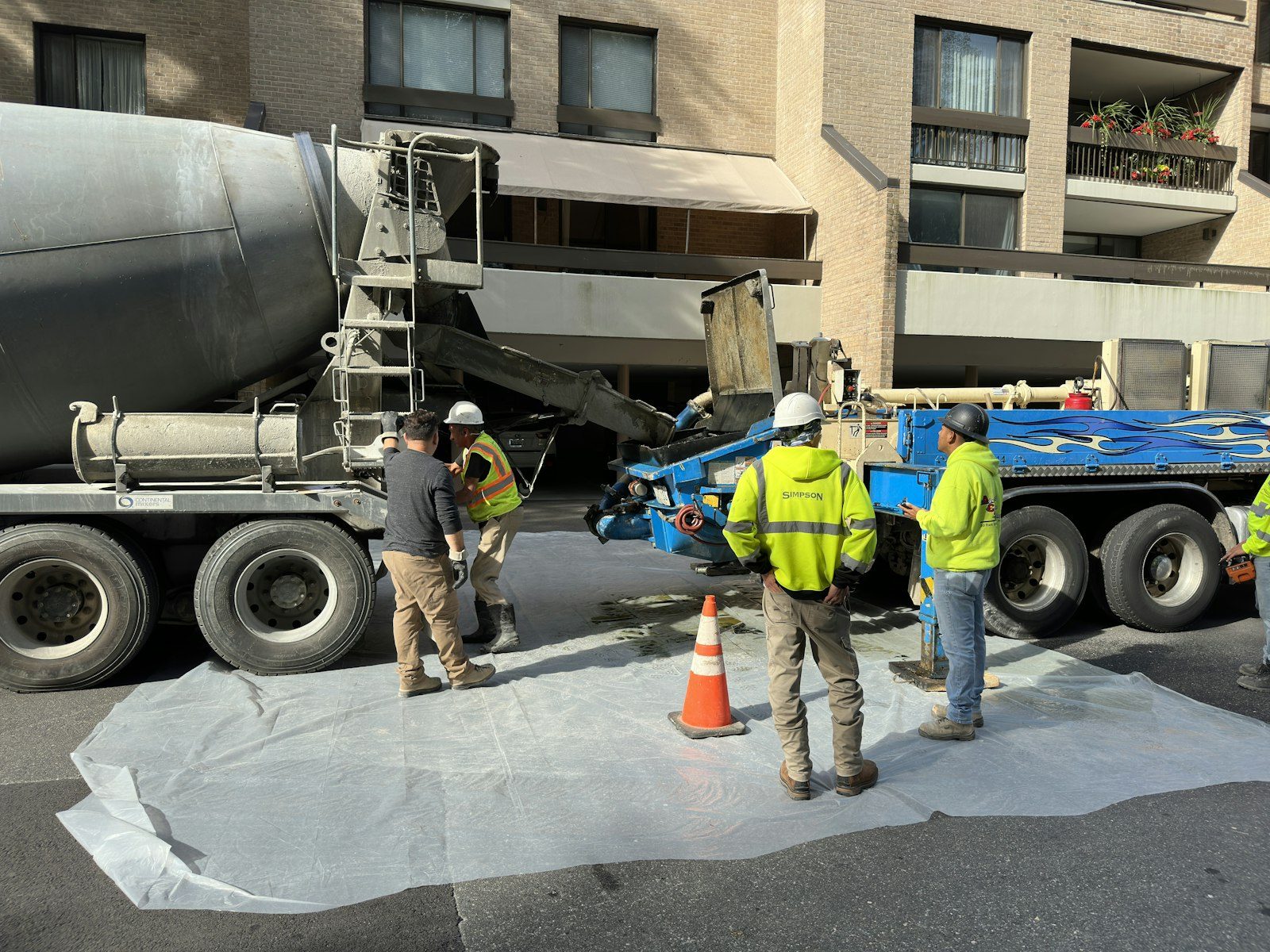
Everything that decides whether a service drive lasts happens before the first ready mix truck shows up.
An access road is a dirt project with a concrete lid on it. That's not a clever line, it's the actual cost structure. The slab is four to eight inches of the assembly and maybe a third of the effort. Everything below it, the two feet of soil, base, and drainage nobody ever sees again, is what decides whether you're driving on it in twenty years or patching it in five.
Around Littleton this work is service drives behind retail buildings, fire lanes that have to hold apparatus, maintenance drives through community property, and yard roads at contractor and equipment operations. It's rarely a mile of new road through open ground. It's usually a few hundred feet of drive that's been gravel or tired asphalt for a long time, and the trucks using it got heavier somewhere along the way.
We dig. Test holes down the length of the route, more of them where the ground changes or where the existing drive is failing worst. What comes out tells us the story: how deep the clay runs, whether there's fill nobody documented, how close the water is, and whether the previous base is worth keeping. A road priced without that is a guess dressed up as a bid.
Then we look at where water goes. Roads fail from the edges in, and they fail from below, and both of those are water problems. If your drive collects runoff from a slope above it, that water has to be intercepted and carried somewhere before it gets under the section. Ditches, culverts, and a cross slope that actually sheds are part of the road, not an add-on somebody can value engineer out.
Then compaction. Subgrade gets proof rolled and tested, base goes in lifts rather than one dump, and each lift gets compacted and checked. This is the boring part of the job and the part that separates a road that holds from a road that pumps mud through its joints the second spring. We won't shortcut it, and if a competing bid is cheaper by a wide margin, the base section is where we'd look first.
Littleton hands us two different subsurface problems depending on where you are. Out along the Ken Caryl edge the ground gets rocky and the grades get real. Rock is good bearing and bad digging, so the road itself is stable and the trenching for drainage costs more. Slope means the road needs steeper cross fall, more attention to where runoff crosses it, and sometimes retaining on the uphill cut.
Down through the flatter areas around Columbine and Southbridge it's clay, and clay under a road behaves differently than clay under a patio. A road concentrates wheel loads in the same two tire paths thousands of times, so any softness in the subgrade gets pumped rather than just settling. That's why we're picky about drainage on flat sites even when nothing looks like it's running downhill.
Both conditions point the same direction: build the section for the worst dirt on the route, not the average. A road is only as good as its softest hundred feet, and that's always the stretch that shows up in your maintenance budget.
| What comes out of the hole | What it means | What we do about it |
|---|---|---|
| Dense clay, dry, uniform | Decent bearing as long as it stays dry | Standard base section, real attention to keeping water off it |
| Wet clay that smears on the shovel | It will pump under repeated wheel loads | Over-excavate, dry or replace, then build base in lifts |
| Loose fill with debris in it | Nobody compacted this when it went in | Remove it to competent ground and rebuild, no exceptions |
| Rock close to the surface | Excellent bearing, expensive trenching | Thinner base, budget shifts to drainage and utility work |
| Old road base still intact | Real value already in the ground | Scarify, add material, recompact, reuse what's good |
| Water in the hole | Groundwater or a leak, either way a road killer | Underdrain and a drainage plan before any section gets priced |
Tell us what runs on it and how heavy. We'll come dig a couple of holes and tell you what a concrete section would actually take.
You can predict where a road will fail before it's built. Walk it after a hard rain and find where the water stands. Those spots are where the joints will pump, where the edge will break off, and where you'll be patching in year four. Fix the water and the concrete mostly takes care of itself.Straight from the crew
Still unsure about something?
Call the crew at (303) 569-4046 and we will talk it through.

Get a free, no-obligation estimate from a crew that knows Colorado soil, Colorado weather, and how to finish concrete that lasts.
Accessibility
Adjust the site to fit how you read and browse. Your choices are saved on this device.