
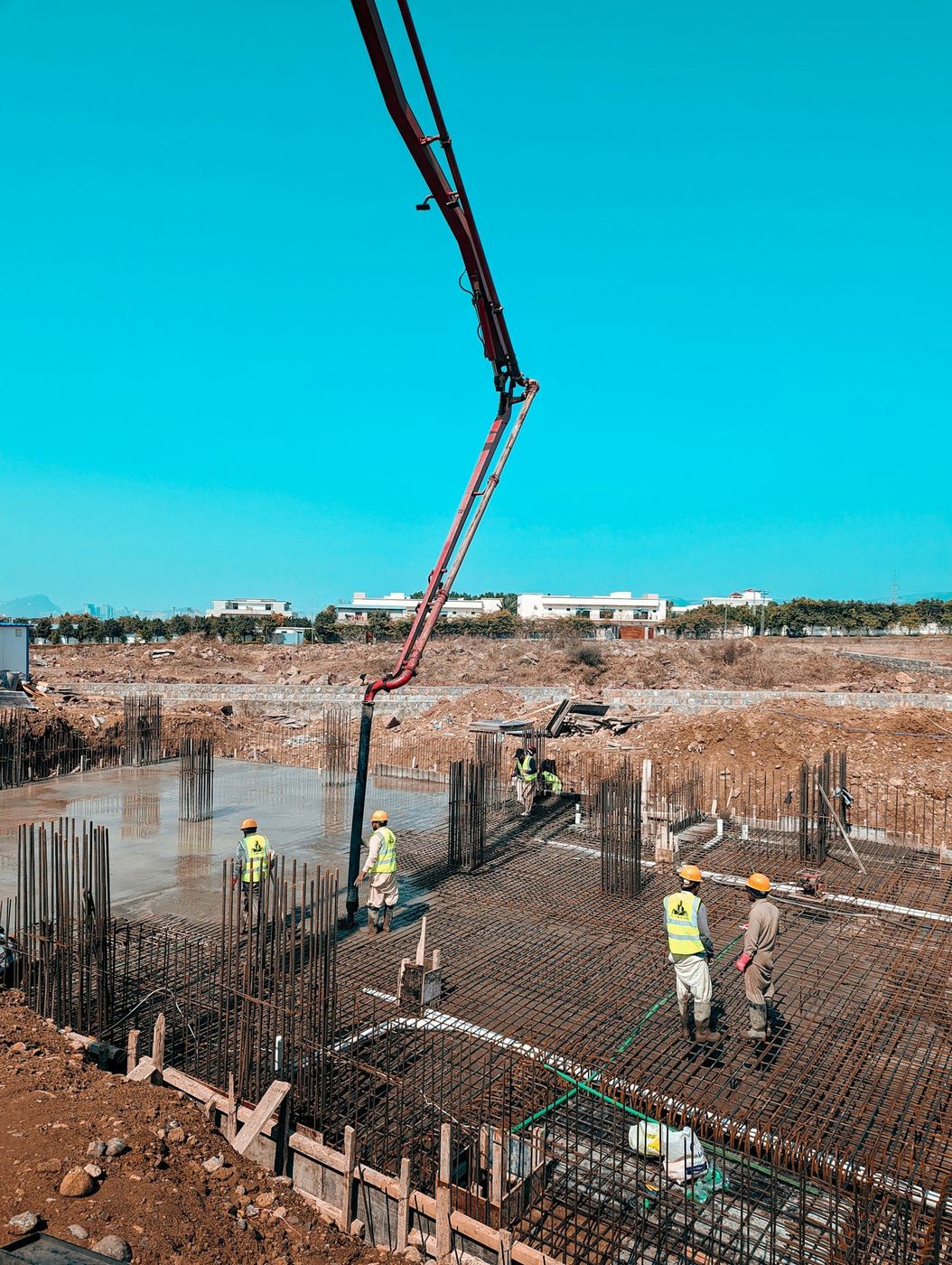
Cement slurry pumped under a sunken slab, because on a lot of these older properties the concrete is the good part.
Here's what keeps this trade alive in a town with Lakewood's housing mix: the concrete on a lot of these properties is better than the dirt holding it up. Slabs poured in the fifties and sixties tend to be honest concrete. Stiff mix, hand finished, no admixtures to argue about. What they usually lack is any real base course. The forms went on graded native soil and the truck showed up.
That combination is exactly what a slurry pump is for. Sound concrete sitting an inch or two low is a candidate for lifting all day long. We drill a pattern of cores, push a sand and cement grout underneath at low pressure, fill whatever hollow has opened up, and float the panel back to where it started. Same concrete. Same finish. Just back at the elevation the builder intended.
| Property type | Where it drops | What that means for a lift |
|---|---|---|
| Mid-century ranch on the flats | Front walk and the porch landing, usually toward the lawn side | Straightforward pump. Clay subgrade is firm enough to carry grout once it's dry |
| Split-level with a tuck-under garage | The apron, which slides away from the garage slab and opens the joint | Very common lift. We work outward from the building so the panel doesn't pinch |
| Home on the Green Mountain slope | The uphill edge, where runoff scours base out from under the low side | Lift works, but the drainage has to change or we'll be back |
| Older Applewood property with big trees | Panels tipped by roots on one side and hollow on the other | Half of these are lifts. The other half want the root handled first |
| Newer Solterra construction | Patio or walk over a utility trench that finished settling on its own schedule | Small void, small lift, and usually a one-morning job |
What we pump is essentially a soupy concrete: washed sand, portland cement, water, mixed to a consistency that flows without segregating. It goes in through cores wider than an inch and a half, considerably bigger than a foam port, and there's a reason for that. Grout has body. It won't chase a hairline void; it fills space and packs it.
Weight is the trade. A cubic foot of set grout runs north of a hundred pounds, so a lift puts real mass back into the ground. On the clay flats around Belmar and Bear Creek that's usually fine, because the soil there has bearing capacity when it's not saturated, and the void you're filling was hollow air anyway. Where we get careful is soft, wet, or organic subgrade. Adding dead load to ground that already quit on you is a short-term win at best. That's the honest boundary of the method, and when a property lands on the wrong side of it we say so.
That combination is the best-case call for us. Let us sound it and tell you whether the pump answers it.
Pumping runs a long season on the Front Range. The grout needs the ground to accept it and it needs a few hours above freezing to take an initial set, which most of our winter days deliver by mid-morning. What stops us cold, literally, is frozen subgrade. Ice under a panel is a solid you cannot displace, and pushing grout against it either does nothing or breaks your concrete. So we watch ground condition, not the calendar.
The other question worth asking is whether to lift before or after other work. If a driveway replacement is two years out, raise the trip hazard now and quit worrying about it. If the yard is getting regraded, do that first, because we would rather pump into a void that has stopped growing. And if a walk is already in small pieces, skip the lift. Nobody raises rubble evenly.
Still unsure about something?
Call the crew at (303) 569-4046 and we will talk it through.

Get a free, no-obligation estimate from a crew that knows Colorado soil, Colorado weather, and how to finish concrete that lasts.
Accessibility
Adjust the site to fit how you read and browse. Your choices are saved on this device.