
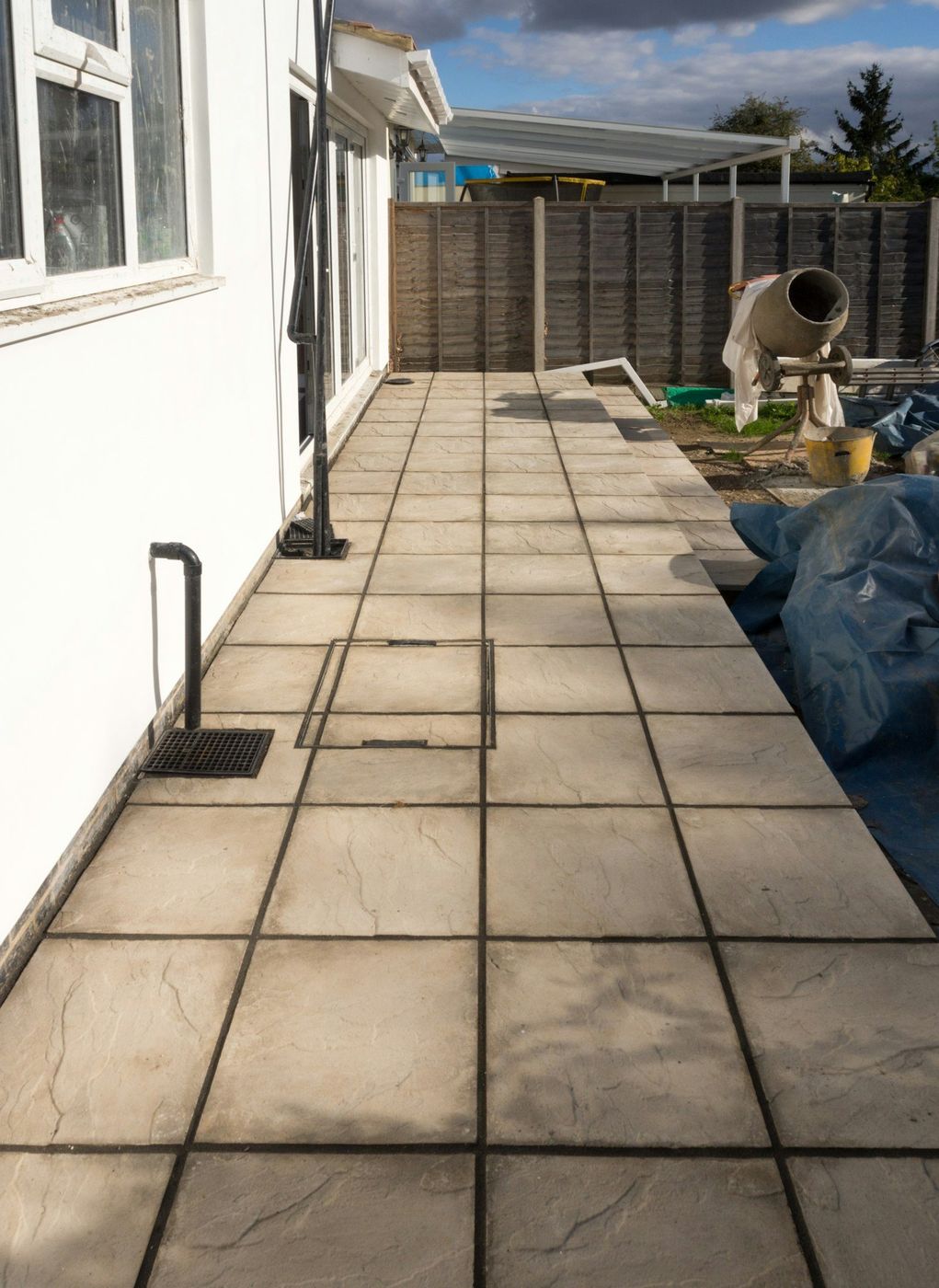
Poured for the way a spa actually gets used here: dark, cold, barefoot, and about four nights a week.
Picture the trip you'll actually make. Nine at night in February, thirty degrees out, robe on, no shoes, ten or twelve steps from the back door to the lid. You do it again in July at dusk with a towel. Two or three times a year you drag a hose out and drain the thing. Once in a while four adults climb in at the same time and the shell takes on a couple thousand extra pounds without warning.
That's the design brief. Not a rectangle of concrete under a box, but a surface that has to be level enough for the shell, wide enough to stand on and towel off, textured enough to be safe when it's wet, and drained so the water that leaves the tub doesn't come back as ice under your feet. We pour for the trip, not just for the footprint.
The pad works twelve months and it works hardest in the cold. Every entry and exit puts water on the concrete right at the edge of the shell. That water either runs somewhere or it sits and freezes, and a spa surrounded by a ring of ice is dangerous in a way people don't anticipate until the first time they slip. So we build fall into the apron around the tub while keeping the bearing area under the shell true.
Chemistry is the second daily fact. Bromine or chlorinated water splashing over the lip lands on the same square foot of concrete a thousand times a season, and it will fade a sealer and etch a weak surface. Then there's the mechanical stuff: a cover lifter bolted through the slab, a step that gets kicked, a set of wet feet dragging grit across the finish. None of it is dramatic. All of it is repetitive, and repetition is what actually wears concrete out.
| What happens most days | What it does to concrete | What we pour in response |
|---|---|---|
| Wet feet on the same landing spot | Polishes a smooth finish into something slick | A light broom or fine texture on the walking apron, held off the tub footprint |
| Splash-out over the lip in winter | Freezes into a ring right where you step | Fall away from the shell on the apron and a discharge point clear of the path |
| Treated water hitting the same edge | Etches weak paste and fades sealer early | A 4,000 PSI air-entrained mix plus a penetrating sealer, renewed on schedule |
| Draining and refilling a few times a year | Dumps a lot of water at one corner in ten minutes | A planned drain path to the yard, never toward the house or a neighbor's grade |
| Four adults getting in at once | A sudden point load shift on one side of the shell | Steel on chairs and a compacted base under the whole footprint, not just the middle |
Placement decides half the build. Around Belmar and the older flats, back yards are generous and flat, and the usual constraint is how far the pad sits from the panel and how far somebody wants to walk in a robe. Closer to the house is better for use and worse for drainage, so we pay attention to which way the ground already falls and where the downspouts land before we set a corner.
Green Mountain and the foothill edges are a different exercise. Sloped yards mean a spa pad is often a small cut-and-fill project with a retaining detail on the uphill side, and the fill side has to be built up in compacted lifts rather than dumped and leveled. Solterra backyards tend to be tighter and newer, which puts the conversation on access, sleeve locations, and HOA rules worth checking before we schedule. Applewood and Bear Creek bring mature trees, so we look up as much as we look down. Nobody enjoys pine needles in the filter every evening.
Send the model's footprint and dry weight. We'll size the slab, plan the conduit, and pour ahead of your delivery date.
Still unsure about something?
Call the crew at (303) 569-4046 and we will talk it through.
Get a free, no-obligation estimate from a crew that knows Colorado soil, Colorado weather, and how to finish concrete that lasts.
Accessibility
Adjust the site to fit how you read and browse. Your choices are saved on this device.