
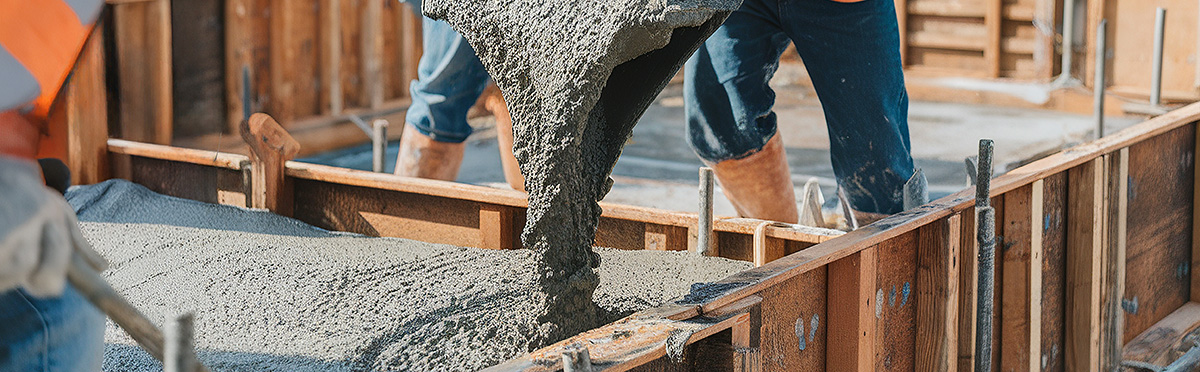
Flat, durable slabs for racking and forklifts.
A warehouse floor is the hardest-working slab on any commercial property. It carries loaded racking that may run twenty feet up, takes forklift wheel loads all day, and grinds against pallet jacks, steel, and grit from one shift to the next. When that floor is flat and built to the right load spec, nobody thinks about it. When it is not, you get racking that will not plumb, lift trucks that buck at every joint, and cracks that spread from the corners of every column. We pour warehouse and industrial slabs to the flatness and load numbers your operation actually runs on, not a generic four-inch pour.
On the Front Range, the ground under that slab is the first thing we plan around. Expansive clay swells when it gets wet and shrinks when it dries, and an industrial floor that ignores that will move no matter how thick it is. We build the base, reinforcement, and joint layout to keep the slab stable and the surface true, so your racking, your equipment, and your inventory sit on something that holds.
Weld County jobs often need heavier pads for equipment and trucks. We size and reinforce them for the real loads. For warehouse & industrial floors, that local knowledge is exactly what protects your investment. We plan the base, drainage, reinforcement, and finish around the conditions on your Greeley property, not a generic detail.
We serve every part of Greeley and the surrounding area, including Promontory, West Greeley, Poudre River Ranch, Trails at Sheep Draw. Wherever you are in Weld County, the crew shows up with the same standard.
At roughly 4,658 feet, Greeley gets intense high-altitude sun and a freeze and thaw cycle that is hard on any concrete poured without care. For warehouse floors, that means air-entrained mixes, deliberate curing, control joints cut on time, and a base prepared for the expansive clay under your property. It is the difference between work that holds for decades and work that starts failing by the first or second spring.
The load on a warehouse floor is not spread out like it is on a sidewalk. It comes down through narrow rack baseplates and forklift wheels, which concentrates a lot of weight onto small footprints. That is what cracks an underbuilt slab. We design the thickness, the base, and the reinforcement around your real loads: the rack capacity, the post spacing, and the class of lift truck you run. Heavy-duty reinforcement and a properly compacted base let the slab carry concentrated weight without spider-cracking out from the column lines. If your operation is adding mezzanines, taller racking, or heavier trucks down the road, we would rather know now and build the floor for it than watch it fail under a load it was never poured to take.
This is the part most buyers underestimate, so we will be straight about it. A warehouse floor that is even slightly out of flat causes daily problems you cannot easily fix later. Tall racking amplifies a small dip into a noticeable lean at the top, which inspectors and safety people do not like. Forklifts and very-narrow-aisle trucks bounce, slow down, and wear faster on a wavy surface. Order pickers feel every ripple. The honest answer is that flatness has to be designed and controlled during the pour, not chased afterward. We pour to the flatness your equipment needs, screed and finish to hold that tolerance, and lay out joints so the slab stays true as it cures. Trying to grind a finished floor flat after the fact is slow, expensive, and never as good as getting it right wet.
Most warehouse floor complaints trace back to the joints, not the field of the slab. Joints take the pounding from every forklift wheel that crosses them, and the edges spall and break down over time. Slab edges can also curl as concrete cures and dries, lifting at the joint and turning it into a bump. We control this with deliberate joint layout, real curing, and joint armoring where the traffic warrants it, so the edges stay supported and protected. Colorado's dry air and big temperature swings make curing discipline matter even more here, because concrete that dries too fast curls and cracks. We cure the slab properly and detail the joints so they hold up to years of wheel traffic instead of becoming the first thing that needs repair.
Everything above the slab depends on what is below it. We start with a compacted, engineered base so the floor has uniform support and no soft spots that let it settle unevenly. On expansive clay, which is common across the metro and out toward the foothills, we plan for moisture: keeping water away from under the slab, detailing drainage where the building needs it, and reinforcing the floor to resist the heave that clay can produce. We have a structural engineer on staff for floors that need one, and we pull and manage permits when the job calls for it. The goal is a slab that does not just look flat on day one but stays stable through the wet springs and dry winters that move so much concrete in this state.
Every Greeley job starts with a free, written estimate and a structural engineer on staff for the work that needs one. Licensed, bonded, and insured, with finishes from a clean broom texture to stamped, colored, and sealed.
You always know what is happening and what it costs before we mix a single yard. Here is the path from first call to final walkthrough.
We visit the site, measure, check drainage and soil, and hand you a clear written quote. No charge, no pressure.
We set the grade, thickness, reinforcement, and finish. Structural work gets engineered and permitted.
Forms, rebar, and a clean pour. We screed, float, and finish to the texture you picked, then cut control joints.
You can walk it in 24 to 48 hours. We walk the job with you and explain how to care for it through the first winter.
Still unsure about something?
Call the crew at (303) 569-4046 and we will talk it through.

Get a free, no-obligation estimate from a crew that knows Colorado soil, Colorado weather, and how to finish concrete that lasts.
Accessibility
Adjust the site to fit how you read and browse. Your choices are saved on this device.