
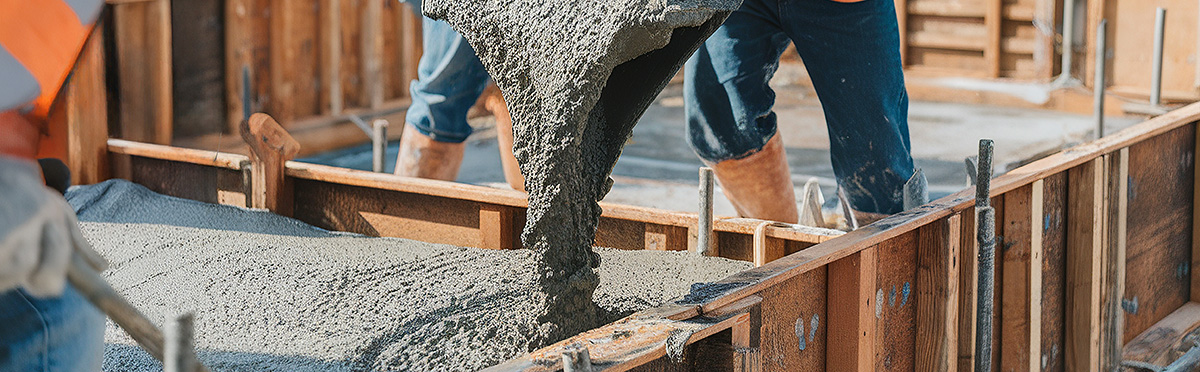
Cast-on-site wall panels for fast commercial shells.
Tilt-up construction is one of the fastest ways to put up a commercial shell. Instead of laying block or framing a wall stick by stick, we cast the building's walls flat on the ground, right there on your slab or a temporary casting bed. Once the panels cure, a crane lifts them up and sets them on the footings, and a wall that took days to form goes vertical in a single afternoon. For warehouses, retail boxes, and industrial buildings across the Front Range, it is a proven way to get a strong, solid envelope up quickly and keep the rest of the trades moving.
The reason it works so well here comes down to the concrete itself. A tilt-up panel is a thick, reinforced wall designed to carry load and stand up to weather, and Colorado throws plenty of weather at it. Hard UV at altitude, swings from a warm afternoon to a freezing night, and wind that pushes on a tall wall all factor into how a panel is mixed, reinforced, and braced. We handle the casting beds, the panels, the embeds, and the finishing the system depends on, and we coordinate with your structural engineer so every piece lifts and lands the way the drawings call for.
Weld County jobs often need heavier pads for equipment and trucks. We size and reinforce them for the real loads. For tilt-up panels, that local knowledge is exactly what protects your investment. We plan the base, drainage, reinforcement, and finish around the conditions on your Greeley property, not a generic detail.
We serve every part of Greeley and the surrounding area, including Promontory, West Greeley, Poudre River Ranch, Trails at Sheep Draw. Wherever you are in Weld County, the crew shows up with the same standard.
At roughly 4,658 feet, Greeley gets intense high-altitude sun and a freeze and thaw cycle that is hard on any concrete poured without care. For tilt-up panels, that means air-entrained mixes, deliberate curing, control joints cut on time, and a base prepared for the expansive clay under your property. It is the difference between work that holds for decades and work that starts failing by the first or second spring.
Most tilt-up panels are cast right on the building's own floor slab, which doubles as the casting bed. That slab has to be flat, clean, and treated with a bond breaker so the panel releases cleanly when the crane picks it up. We plan the casting layout before the first yard of concrete shows up: where each panel sits, how they stack or share bed space, and how the lift sequence runs so the crane can reach every piece. Get that layout wrong and you end up with panels you cannot pick in the right order. We pour the beds level and smooth, set the forms to the panel dimensions, and keep the surface true so the finished face comes off the way it should. The bed is the mold, so the bed has to be right.
A wall panel takes its biggest stress not in service but during the lift, when the crane peels it off the bed and rotates it upright. That single moment can crack a panel that was not reinforced for it. We place rebar to the engineer's mat design, set the lift inserts and bracing inserts exactly where the rigging plan calls for them, and cast in the embeds that connect panels to the structure and to each other. Reveal forms, blockouts for doors and windows, and weld plates all go in before the pour, because there is no adding them later. Precision here is not optional. An insert an inch off or a missing embed turns into a field problem the day of the lift, so we set them carefully and check them against the shop drawings before concrete goes in.
This is the honest concern every owner has, and it is a fair one, because a cracked panel is expensive and slow to fix. The risk is real but it is manageable, and managing it is most of the job. Panels crack on the lift for predictable reasons: concrete picked before it reached the strength the engineer specified, lift inserts placed wrong, or rigging that puts stress where the panel cannot take it. We pour to a mix designed for tilt-up, cure it properly so it gains real strength, and we do not let anyone pick a panel until test breaks confirm it is ready. In Colorado that curing matters even more, because a cold night can stall strength gain if the panel is not protected. We set the inserts to the rigging plan, coordinate the lift with the crane crew and the engineer, and brace each panel the moment it is standing. Done that way, panels go up clean.
The face of a tilt-up panel is the face of the building, so the finish is both looks and protection. We can leave a smooth troweled surface ready for paint, form reveals and recesses for shadow lines and a more designed look, or work in exposed aggregate and color where the project calls for it. Whatever the finish, sealing matters here. At altitude the UV is harsh and the freeze-thaw cycle works on any moisture that gets into the surface, so a sealed panel holds its color and resists scaling far better than a bare one. We finish the cast face on the bed, where we have flat, easy access to it, then handle any patching at the lift points and panel joints once the wall is standing and braced.
Every Greeley job starts with a free, written estimate and a structural engineer on staff for the work that needs one. Licensed, bonded, and insured, with finishes from a clean broom texture to stamped, colored, and sealed.
You always know what is happening and what it costs before we mix a single yard. Here is the path from first call to final walkthrough.
We visit the site, measure, check drainage and soil, and hand you a clear written quote. No charge, no pressure.
We set the grade, thickness, reinforcement, and finish. Structural work gets engineered and permitted.
Forms, rebar, and a clean pour. We screed, float, and finish to the texture you picked, then cut control joints.
You can walk it in 24 to 48 hours. We walk the job with you and explain how to care for it through the first winter.
Still unsure about something?
Call the crew at (303) 569-4046 and we will talk it through.
Get a free, no-obligation estimate from a crew that knows Colorado soil, Colorado weather, and how to finish concrete that lasts.
Accessibility
Adjust the site to fit how you read and browse. Your choices are saved on this device.