
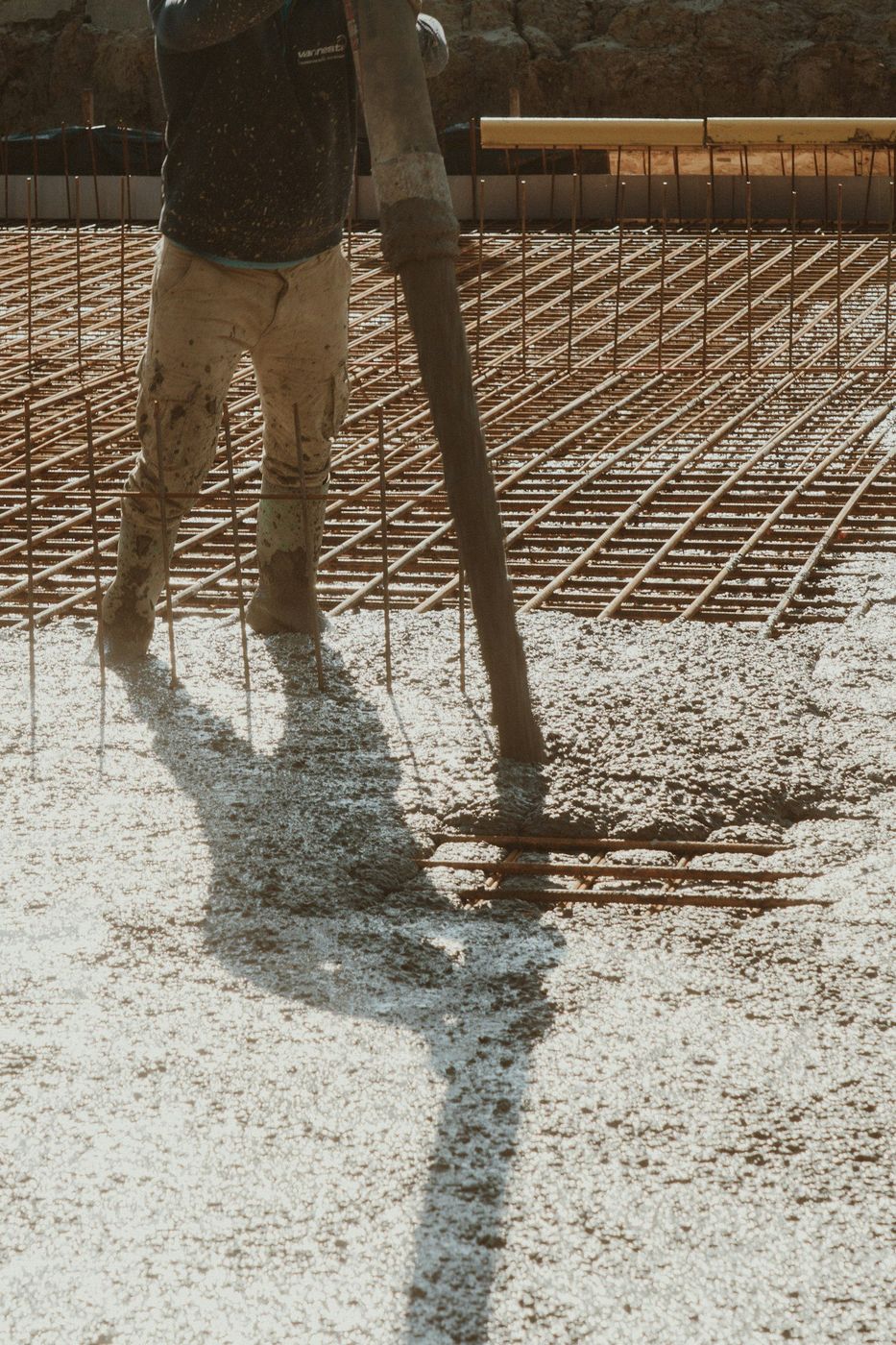
A failing shed pad announces itself through the building sitting on it, never through the concrete.
You will almost never notice a shed pad going bad. You'll notice the shed. The double doors that used to swing shut now need a shoulder, or one leaf drags on the corner. A gap has opened between the bottom of the siding and the concrete on the low side, wide enough to see daylight through. The roof ridge, which was dead flat against the fence line for years, now runs slightly downhill.
Every one of those is the ground under the slab talking. We build and replace shed pads all over Fort Collins, from deep back yards in Registry Ridge and Fossil Creek to tight alley-side spots behind older Old Town properties, and the diagnosis almost always starts by looking at the building rather than the concrete.
Stand at the back of the yard and look at the shed as a rectangle. Vertical lines should be vertical and the roof line should be straight. When a pad tips, the whole box goes with it, and the eye catches that long before anybody measures anything. Doors are the loudest symptom, because a door frame is square and the building around it no longer is. Windows bind the same way.
Then look at the bottom edge. A dark stain along one wall means water runs along the pad instead of off it, wicking up into the siding. Rodent holes at a corner mean there's a void under the slab that something found. Rust at the base of a metal building tells you meltwater sits there every March. And if a wheelbarrow parked inside always rolls to the same corner, you don't need a level, though we'll bring one anyway.
| The fix | When it holds up | When it only buys a season |
|---|---|---|
| Foam lifting the slab back to level | The pad is intact, poured thick enough, and simply settled as a unit | There are cracks through it, or the water that washed the soil out is still running there |
| Regrading and drainage work around the pad | Movement is seasonal and the pad itself is sound | The building has already racked and the frame needs squaring anyway |
| Pouring a new apron strip at the doorway | The pad is fine but the threshold has eroded and the door drops off an edge | The whole low side is settling and the apron will follow it down |
| Cutting out and repouring one corner | The failure is local, with sound concrete and solid ground everywhere else | The base was thin under all of it, which is usually the case |
| Full removal and a new pad | Anything cracked through, undersized, or built without base | Never, honestly. It's the answer when the cheaper ones don't apply |
Send a photo of the shed straight on from the side and one down the bottom edge. We'll read it and tell you what we'd do.
Your house sits on footings dug below frost and it heats the ground beneath itself all winter. A shed does neither. It's a cold box on a shallow slab, so frost gets under it from every direction, and the north side of a pad shaded by a fence can stay frozen for weeks after the sunny side has thawed. That difference across a few feet is what tips a building.
Water decides how bad it gets. Most sheds have no gutters, so every storm dumps a line of roof runoff along both long sides, right where the slab edge meets soil. That water soaks in, freezes, lifts, and over years it carries fines out from under the edge and leaves a void. Our answer is base depth, a pad sitting proud of the surrounding grade rather than in a bowl, and fall away from all four sides.
Timing is straightforward. April through October is our window, with early fall the easiest: firm ground, mild days, time to cure before the freeze. Spring is fine once the ground dries enough to compact, and a soggy April subgrade is worth waiting two weeks for. Small pads can go in late in the season with warm water and blankets. We won't set one on frozen ground, ever.
Still unsure about something?
Call the crew at (303) 569-4046 and we will talk it through.
Get a free, no-obligation estimate from a crew that knows Colorado soil, Colorado weather, and how to finish concrete that lasts.
Accessibility
Adjust the site to fit how you read and browse. Your choices are saved on this device.