
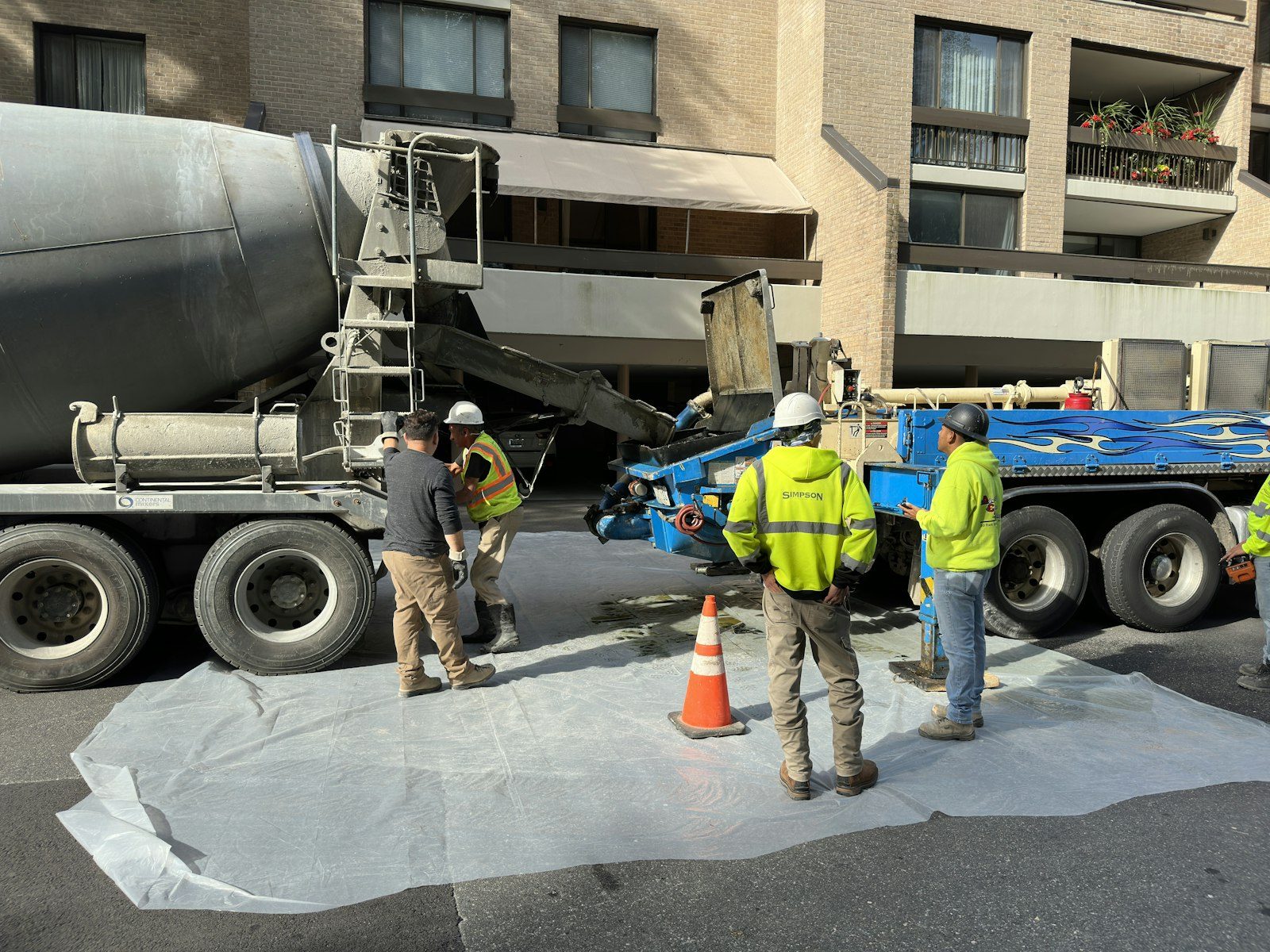
Nobody wants concrete. They want the rig home, off the gravel, and sitting level.
The math on an RV pad is not really about concrete. It's about a storage bill that shows up every month whether you use the rig or not, a forty-minute round trip every time you want to load it, and a gravel patch beside the garage that turns into ruts by the second spring. Concrete ends all three. What it costs depends far less on square footage than most people expect.
We build pads all over Fort Collins, from side yards in Registry Ridge and The Landing to tight alley approaches behind older properties near Old Town. Two pads of identical size can be quoted very differently, and the difference is almost never the concrete itself. It's what we have to do to the ground first, and how we get equipment to it.
Square footage sets the floor. After that, five things swing the number, and you can influence three of them. Access is first. If a truck can back to the forms and chute directly, the pour is a couple of hours. If the pad sits behind a gate, past a corner, or down the side of the house with three feet to spare, everything moves by buggy or pump, and that's labor and equipment before a single yard is placed.
Excavation and haul-off is second. Deep base means dirt leaving the property, and dirt is heavy. Third is grade. A pad has to be near level for the jacks, so a sloping side yard turns into either a cut into the hill or a built-up section with retention at the low edge. Fourth is thickness and steel, driven by what parks on it, and that one is not worth trimming. Fifth is everything you attach: apron, utility sleeves, a strip along the door side. Those are cheap now and painful later, which is the whole point of the next table.
| Upgrade | During the pour | After the concrete is down |
|---|---|---|
| Conduit for a power outlet at the pad | A sleeve laid in the trench before base goes in | Saw cutting, breaking out a strip, patching a seam that will always show |
| A hose bib line to the parking spot | Trenched with everything else, one open ditch | A second excavation crew and a scar across the finished slab |
| Extra length for a longer trailer | More forms and more yardage on the same trip | A cold joint, a second mobilization, and two slabs that age differently |
| A walking strip along the door side | Poured monolithically with the pad | A separate small pour that settles at its own rate |
| A thickened edge under the jack points | A deeper trench where the forms already are | Not really fixable. You live with the dimples or you replace |
We'll measure the approach, check the grade, and hand you a line-item quote you can actually compare. Free, and we don't chase.
A pad carries weight in a few small places. Tires, jack feet, and sometimes a tongue jack, all of it concentrated and all of it parked in one spot for months. That's a different problem than a driveway, where the load moves and never sits. Then the rig itself becomes a weather shield: the slab under it stays dry and cold while everything around it soaks and freezes. Edges take the worst of it, which is why the apron and the outside foot of a pad are usually the first things to break down on a job that was built thin.
Up here the freeze cycles are longer and harder than the metro sees, so we run air-entrained mix, keep the slab pitched so nothing ponds under the rig, and cut joints on a grid that matches the pad's shape rather than a default spacing. Timing is easy for once. Fall is the best window we have. The rig is stored, the crew has room to work, and the concrete gets weeks of mild curing weather before winter. Spring works too, as long as we can get in after the ground dries out. Mid-summer pours start early to beat the afternoon storms.
The pads we tear out almost always failed in the same two feet: the outer edge where the tires cross getting on. Somebody saved base right where the wheel load lands hardest. We build that edge heavier than the middle now.From the crew lead on these jobs
Still unsure about something?
Call the crew at (303) 569-4046 and we will talk it through.
Get a free, no-obligation estimate from a crew that knows Colorado soil, Colorado weather, and how to finish concrete that lasts.
Accessibility
Adjust the site to fit how you read and browse. Your choices are saved on this device.