
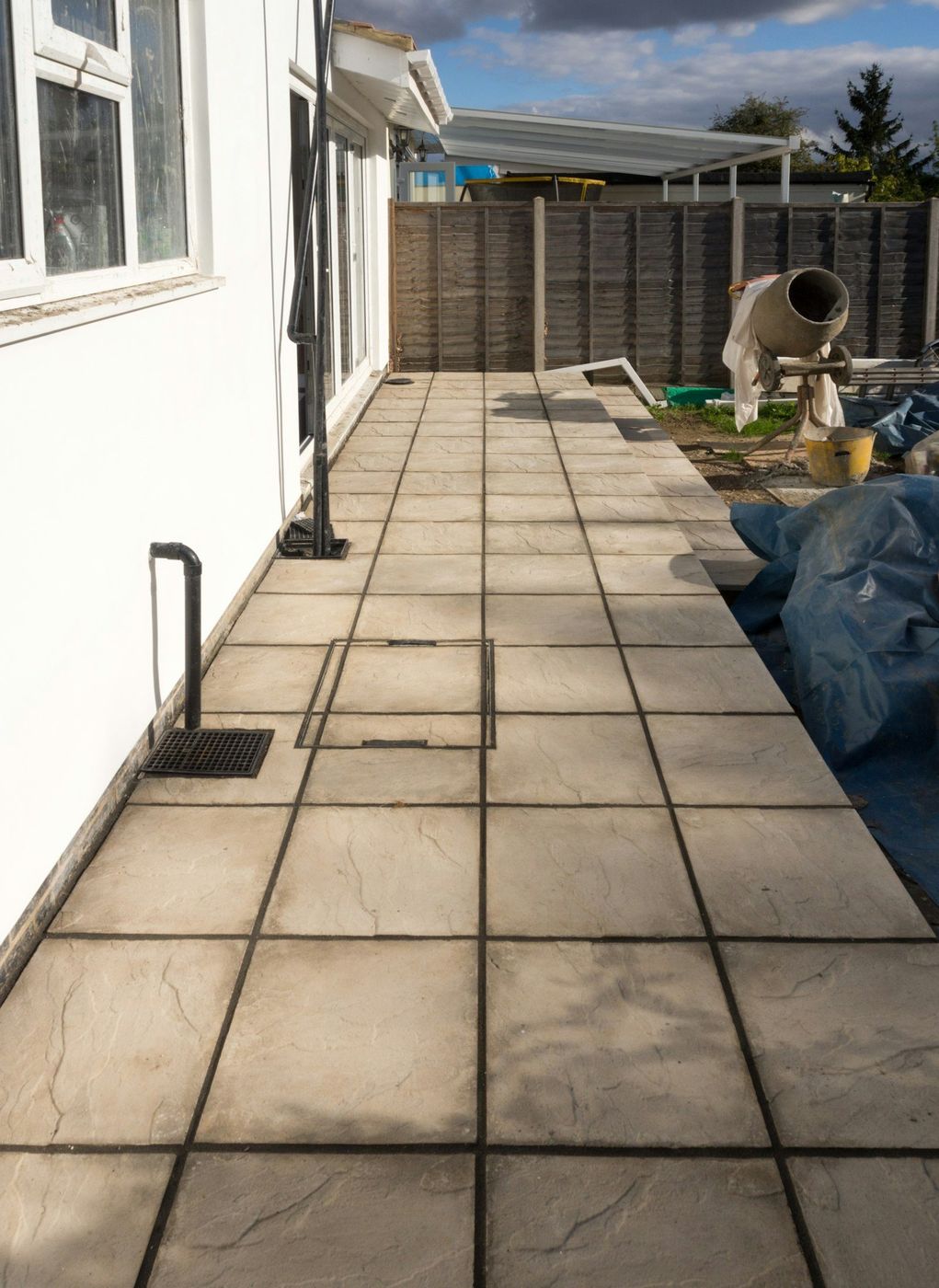
Cutting the lines is the easy part. Deciding what lives inside them is what you notice every March.
Scoring is the least expensive thing anybody can do to make a slab stop looking like a slab. A chalk line, a saw, a pattern sized to the space, and a plain gray rectangle starts reading as something somebody meant to build. That part is honestly not complicated, and on most patios it's a day of work.
The decision people never see coming is what happens inside those grooves after we drive off. An open kerf, a sand fill, and a flexible sealant are three genuinely different surfaces to live with, and in a place where the slab crosses freezing a few hundred times between October and April, that pick matters more than the pattern does. So we spend most of this page there.
A good candidate is boring to describe. Flat, sound, no active cracking, a surface that isn't dusting when you drag a shoe across it. If the slab is in that shape, scoring is one of the better returns available on concrete you already own, and we cut plenty of patios in Rigden Farm and The Landing that were fine slabs and dull rectangles.
The ones we turn down are just as easy to spot. A surface that's scaling or chalking is already failing, and running a saw through it opens more edge for water to attack. A slab with a section that has settled is telling you the problem is underneath, and no pattern hides a trip hazard. And a patio already crowded with badly placed control joints usually gets worse with more lines, not better, because the eye reads clutter before it reads design.
The other thing we push back on is scale. Almost everybody's first instinct is lines too far apart, which leaves the pattern looking like an afterthought. We size the grid to the space and to the house, and on a big open patio out toward Fossil Creek that often means smaller units than the homeowner pictured. Chalk it out, stand on the back step, and look before anybody starts a saw. That two-minute habit has saved more patios than any tool we own.
People use the words interchangeably and they shouldn't. A control joint is structural housekeeping. It goes about a quarter of the way through the slab, which is deep enough to create a weak plane and force the inevitable shrinkage crack to happen where we chose. A decorative score line is a shallow groove, usually somewhere between an eighth and a quarter inch, deep enough to throw a shadow you can read standing up and shallow enough that it doesn't create a fracture plane we didn't ask for.
On a new pour the order is fixed. Control joints get cut the same day, while the concrete is green, because waiting means the slab cracks on its own schedule instead of ours. Decorative scoring waits until the surface has hardened enough to hold a crisp edge, which is usually a few days out. On an existing slab we find and mark the joints already there first, then draw a pattern that swallows them, so the joints stop looking like damage and start looking like part of the grid.
We cut most of the year, but the cold end of the calendar has real limits, and they come from the fill rather than the saw. Anything we put in a line needs temperature to cure. Wet cutting in freezing weather is its own problem, since the slurry has to go somewhere and it will not go anywhere useful at twenty degrees.
| How the line is finished | How it acts in winter | Where we'd use it |
|---|---|---|
| Left open | Water goes in, drains out, and freezes with room to expand. The most forgiving option there is | Almost everywhere outdoors. This is our default and we'll argue for it |
| Sand or polymeric fill | Holds moisture in the groove. Polymeric copes better than plain sand does | Flat patios with good drainage, where a filled line just reads cleaner |
| Flexible sealant | Keeps water out completely and stretches with the slab. Most labor of the three | Lines doing real joint duty, and any line near a door or the foundation |
| Rigid grout or mortar | Cracks out the first hard winter, then keeps cracking out | Nowhere outdoors up here. Indoors is a separate conversation |
Send us the photo and we'll tell you honestly whether the scale is right. (303) 569-4046.
Still unsure about something?
Call the crew at (303) 569-4046 and we will talk it through.

Get a free, no-obligation estimate from a crew that knows Colorado soil, Colorado weather, and how to finish concrete that lasts.
Accessibility
Adjust the site to fit how you read and browse. Your choices are saved on this device.