
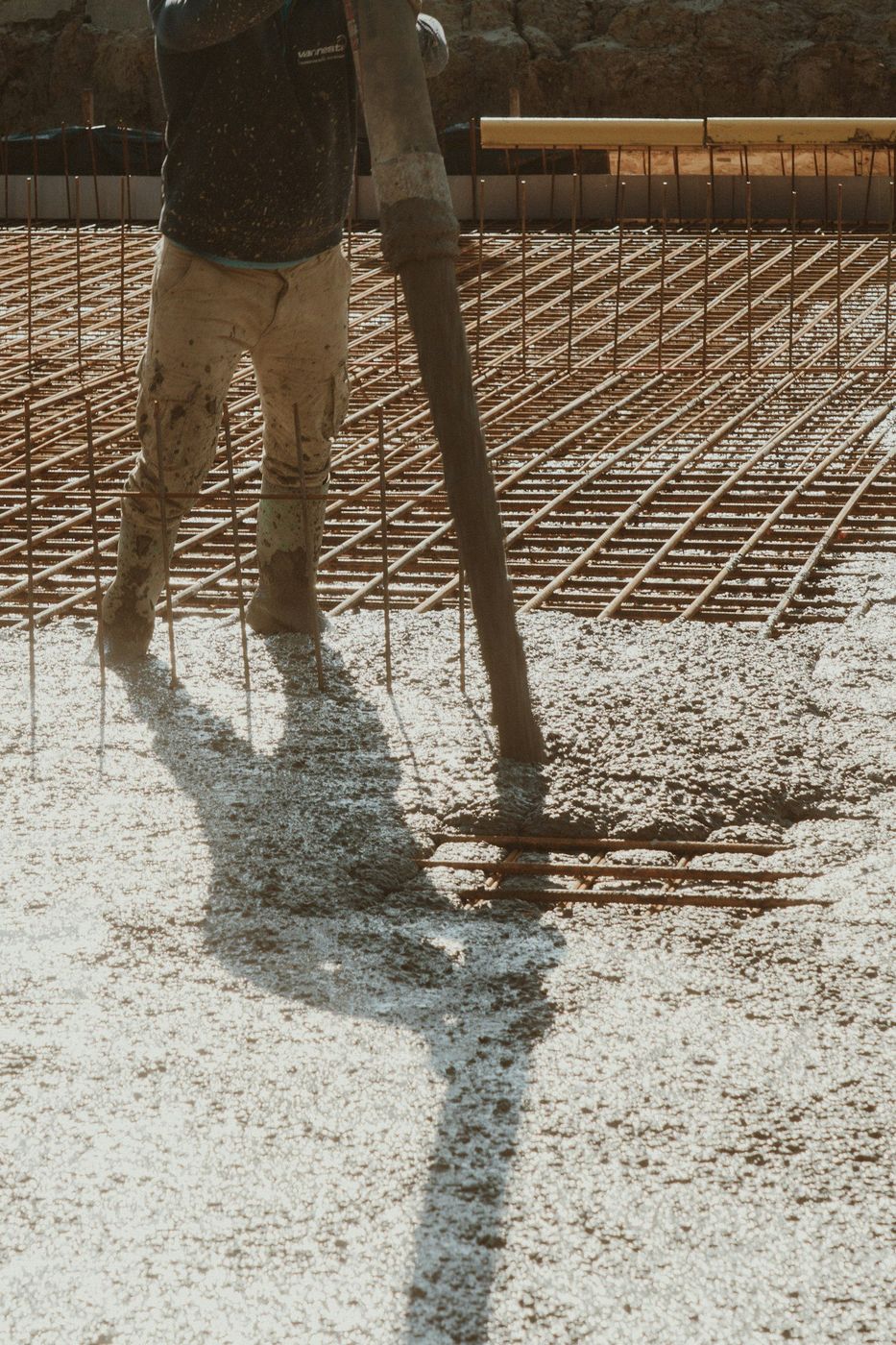
Five people, four hours, and a wet edge that never once gets to stand still.
An overlay day looks nothing like a pour day, though people book one expecting the other. No ready-mix truck idling at the curb. No chute. Instead there are bags, water measured by weight, two mixers running in rotation, and a material that starts stiffening the moment it leaves the bucket. The topping sets the pace and we organize ourselves around it.
Here's what actually happens at a Fort Collins house from the time we unload to the time we pull the tape. Knowing the sequence is the difference between a homeowner who thinks the crew is rushing and one who understands why nobody breaks for lunch. It also explains most of what an overlay costs. A quarter inch of material, and an awful lot of choreography around it.
Everybody watches whoever has the trowel. The one who matters is the guy on the mixer. Let two batches in a row come out different and you'll see that line from the kitchen window for the next fifteen years.Our crew lead, after the walkthrough
Bond is mechanical. A topping doesn't glue itself to a smooth surface, it keys into a roughened one, so the first hours go to making a profile. Shot blasting is our default: even texture, and the dust goes into a vacuum instead of the neighborhood. Grinding handles edges and anywhere a blaster can't reach. Acid does none of this well and we don't use it for prep.
Then everything loose has to leave. We vacuum, then vacuum again, because the difference between a topping that lasts and one that sounds hollow in three years is usually a film of dust nobody bothered with. Old sealer gets stripped, not blasted through and hoped over.
Last, we wet the slab and let it drink. A thirsty old slab pulls mix water straight out of a fresh topping and leaves you a weak, chalky surface. We want it saturated with no standing water, and in this dry air that means going back over it more than once. Tape and plastic go on the house and anything within splash range. Only then does a bag get opened.
| Position | What they're watching | What happens if they blink |
|---|---|---|
| Mixer | Water by weight, mix time on a timer, color from batch to batch | Two shades of gray in one patio, and it never blends out |
| Hopper and hose | Keeping material moving so the wet edge never stops advancing | A cold joint straight down the middle of the slab |
| Gauge rake and screed | Thickness, checked by feel every few feet | Thin spots that debond first, thick spots that crack |
| Texture | How stiff the surface is right now, not how it felt two minutes ago | Broom lines that fade at one end and gouge at the other |
| Edges and detail | Every termination: thresholds, steps, drains, the line against old work | A lifted edge, which is where most topping failures begin |
Tell us and we'll call you when one is going down nearby. (303) 569-4046.
Texture is the last decision and its window shuts on its own. Broom for grip, sponge float for something softer, knockdown for texture without a pattern, or stamping on a thicker stampable system. Whichever it is, the crew reads stiffness by hand and works across the slab in one direction, because a surface touched twice at different set stages shows both passes.
Every joint in the old slab gets carried up into the new one. That isn't optional. The concrete underneath keeps moving at those lines whether anything covers them or not, so we tool the joint in wet or cut it the same day, directly over the original. Place a topping across a live joint and it cracks there inside a year, raggedly instead of straight.
Curing matters more here than most places. A quarter inch holds no water in reserve and our air takes what little there is, so a cure coat or plastic goes on and stays. Walk on it the next day, furniture in two or three, vehicles at a week on a drive. Sealer waits until the topping has truly dried.
We place from late April into the first week of October. Not below about fifty degrees and falling, and never with a hard freeze inside the next day, because a green topping that freezes is a loss rather than a repair. September is the month we'd pick: mild days, calm mornings, storms finished for the year. Patios in Rigden Farm and Fossil Creek, porch landings around Old Town. By November we move indoors to heated shops, where the calendar stops mattering.
Still unsure about something?
Call the crew at (303) 569-4046 and we will talk it through.
Get a free, no-obligation estimate from a crew that knows Colorado soil, Colorado weather, and how to finish concrete that lasts.
Accessibility
Adjust the site to fit how you read and browse. Your choices are saved on this device.