
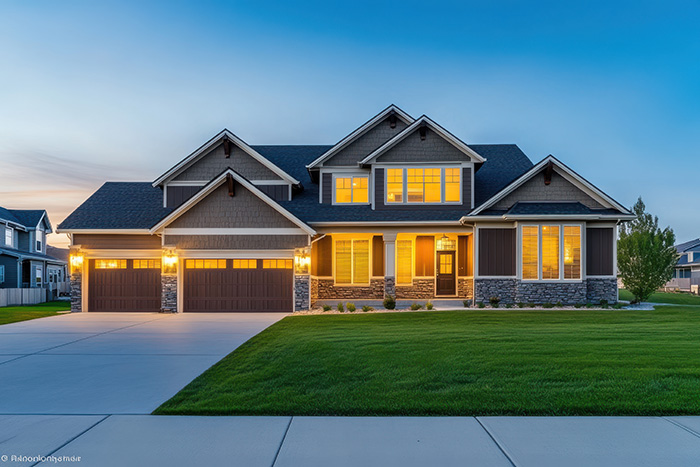
The first freeze warning of the year is when the phone rings about outdoor counters, and by then every decision that matters was made in April.
Somewhere in the back half of October the forecast puts up a freeze warning and our voicemail fills with people worried about the concrete top on their grill island. Fair worry. Also about six months late, because whether a slab of cast concrete gets through a Larimer County winter outdoors was settled in a shop back in spring, in the mix, the steel, and the sealer nobody was thinking about at the time.
We build plenty of tops for kitchens and bathrooms, and those live an easy life indoors. This page is about the other ones. Bar counters, grill surrounds, and prep surfaces that sit outside through five months of freezing nights, blowing snow, and sun that doesn't quit at this elevation. That's the harder build, and the difference between one that lasts and one that spalls at the corners comes down to a handful of choices.
Water gets into the pores, freezes, expands, and pushes. Same physics as a driveway. The defense is different, though, and that difference trips up people who assume a countertop is just small concrete.
On a sidewalk we fight freezing with air entrainment, millions of tiny bubbles giving the ice somewhere to go. You can't do that in a countertop. Those same bubbles show up as pinholes on a polished face and they weaken a section that's already thin. So the strategy flips. We build a mix with so little water in it that there's barely any pore network to fill, we grind and fill the surface until it's tight, and we put a sealer over the whole thing that keeps liquid water from ever getting in.
Then we watch where water collects. Freeze damage on outdoor tops almost never starts in the middle. It starts at the drip edge, at the inside corners of a cutout, and under whatever somebody left sitting out. A cutting board or rubber mat left through January traps meltwater against the surface, holds it there through a dozen cycles, and leaves a pale bloom shaped exactly like the thing that caused it.
| Time of year | What the top is up against | What we ask of you |
|---|---|---|
| Late spring | Runoff, pollen, and the first heavy use since fall | Wash it, watch how water beads, and book a reseal if it doesn't |
| Midsummer | Hard sun, wide daily swings, grease and citrus | Wipe spills the day they land. Acid marks a top, heat rarely does |
| September | The last reliably dry stretch of the year | This is the window. Reseal now so the film is fresh going in |
| First freeze warning | Water already sitting in the pores and in the cutout corners | Clear standing water, pull mats and boards, vent the cover |
| Deep winter | Cycle after cycle, and meltwater under anything left out | Leave the surface bare. Sweep snow off instead of chipping ice |
| Early spring | Whatever the winter managed to find | Check the drip edge and the cutout corners first. Trouble starts there |
Call us before the masonry goes up, not after. The base decides half the outcome. (303) 569-4046.
A countertop is a beam, and a thin one. It spans between cabinets or across a grill opening and it carries load in bending, so the steel goes where the tension is and gets doubled around every cutout. The inside corner of a sink or grill opening concentrates stress harder than anywhere else on the piece, and that corner is where an underbuilt top cracks, every single time. We reinforce it accordingly and we radius it rather than leaving a sharp inside angle.
Casting happens face down in a mold at our shop, which gives a dense, glass-smooth surface straight off the melamine. It cures under plastic, then gets demolded, ground, filled, and polished until the pinholes are gone. Sealing splits by location. Indoor tops get a food-rated system with wax over it as a sacrificial layer you can refresh yourself. Outdoor tops get something breathable and UV-stable, because a film that traps moisture in a slab facing five months of freezing does more harm than no sealer at all.
What the top rests on matters as much as the top. An outdoor island needs a base that isn't moving: footings below frost depth, or a properly built patio slab under it. We set pieces on shims and flexible pads rather than bonding them tight, so the concrete can move with temperature instead of fighting the masonry.
Shop work runs all twelve months, which makes winter a good stretch for kitchen and bath tops in Old Town remodels or new construction off Harmony. Outdoor installs are seasonal. We set and seal those from spring into early fall so the sealer cures warm. Anything an island still needs in late October, we template now and set in April.
Still unsure about something?
Call the crew at (303) 569-4046 and we will talk it through.
Get a free, no-obligation estimate from a crew that knows Colorado soil, Colorado weather, and how to finish concrete that lasts.
Accessibility
Adjust the site to fit how you read and browse. Your choices are saved on this device.