
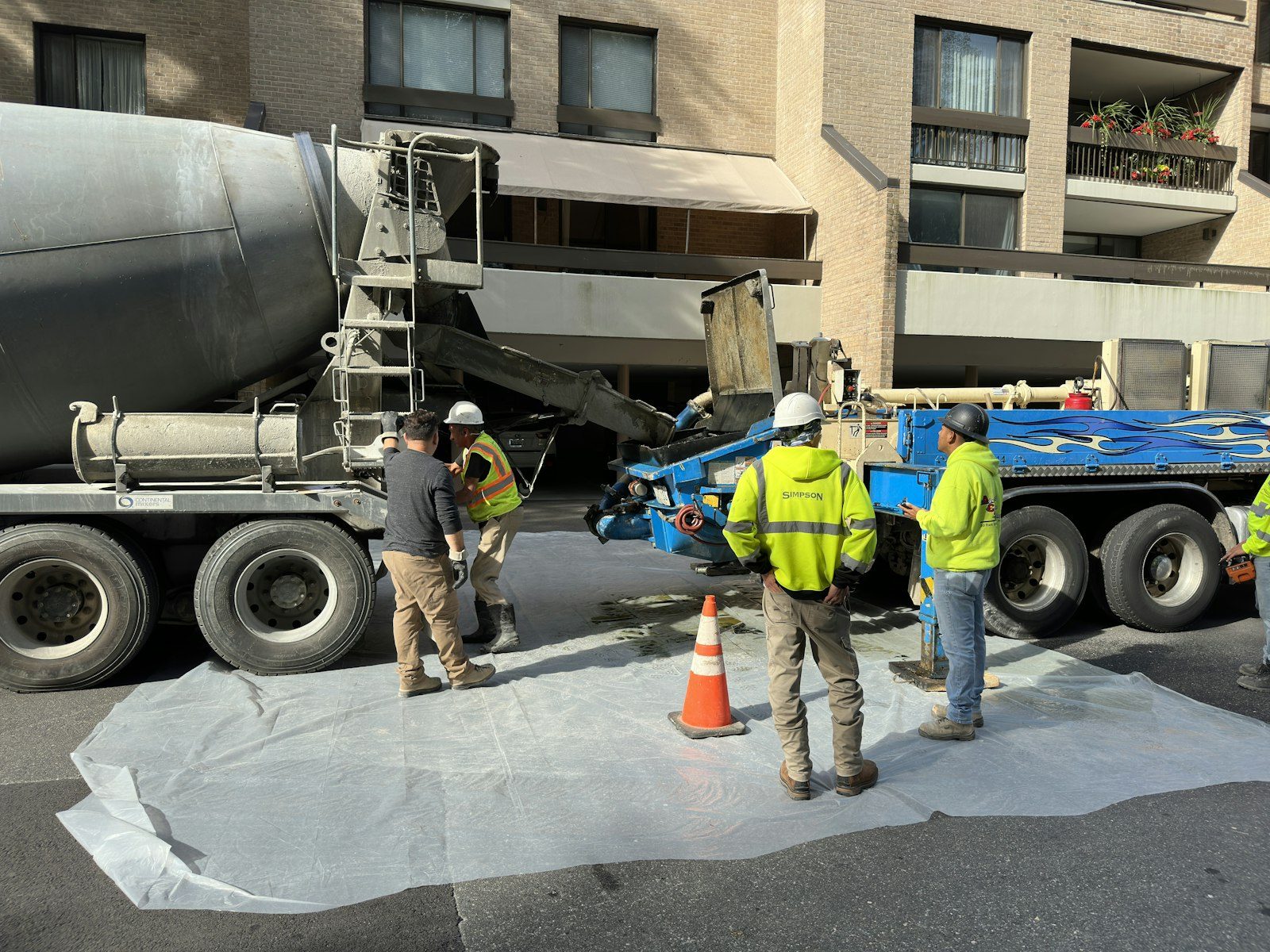
Almost every hard pergola footing has an easy version three feet away. Worth knowing which one you're buying.
A pergola kit assumes your back yard is a flat, empty, uniform rectangle. Yours isn't. There's a patio somewhere, an irrigation main running who knows where, a tree with opinions about its roots, and a corner where the builder's fill went in deep and nobody ever came back to check on it. The kit doesn't know about any of that.
So every one of these jobs turns into the same decision, repeated once per post: build through whatever is in the way, or move the post and build the easy version. Both are legitimate. They cost very different amounts, and on Englewood's compact back yards the choice comes up more often than it would on a big open lot. We'd rather walk it with you before anything is ordered than hand you a change order after the first hole opens.
People arrive with a location already fixed in their head, usually because of shade, or the door it lines up with, or where the table goes. That's a real requirement and sometimes it wins. But it's worth knowing you're choosing it, because a post position is the cheapest thing to change and the most expensive thing to force.
Take the patio case. If the slab is sound and the pergola has to sit on it, we can core through, reach proper bearing underneath, set the support, and patch the surface. That's a legitimate piece of work and it's more expensive per post than drilling in open lawn by a good margin. Move that post off the slab edge and the same support costs a fraction.
Or take builder fill. On lots where a house was pushed into a grade, one corner of the yard can be several feet of material that never got compacted properly. A post landing there needs a support that reaches past it. That one you often can't design around, because fill doesn't sit in a convenient square. But you'd like to know about it before you're committed, not after.
| What's in the way | Building through it | Moving the post instead |
|---|---|---|
| A sound patio slab in the way | Core the slab, reach bearing below, set the support, patch the surface | Costs nothing structural, but the pergola isn't where you pictured it |
| Irrigation main or low voltage lighting | Hand exposure, a rerouted line, and another trade in the schedule | Usually quick and cheap, if the layout has any give in it |
| Structural roots of a tree you want to keep | A hole placed to miss the important roots, sometimes reaching deeper | The shade you're building already exists there. Take the hint |
| Deep uncompacted fill in one corner | A support that reaches past the fill, the biggest single cost on this page | Often not available, because fill is rarely confined to one tidy spot |
| The gas or electrical service | Not a negotiation at any price | The only right answer, and locates happen before we mark anything |
| Low ground where water sits after a storm | A post base living in wet soil, which shortens the hardware's life | Move it a few feet, or fix the drainage you were going to fix anyway |
We're not arguing everything should move. Plenty of times the location genuinely matters, and here's our test: if moving the post changes what the structure is for, spend the money. Shade lands where the sun says it lands, and a pergola shifted four feet west to save on one hole is a pergola that stops shading the table at five in the afternoon. That's a bad trade.
Same with alignment. A structure that lines up with a door, a window, or an existing patio edge looks intentional. One that's three feet off looks like a mistake forever, and nobody remembers why. If the layout is doing real work visually, hold it and pay for the harder support.
What we push back on is the arbitrary version, where a post lands on top of something difficult purely because that's where the tape measure fell. Slide it, rotate the whole frame slightly, or change the bay spacing and let the beam do the work. Cheaper, and you'd never know the difference standing under it.
We'll mark the layout in your yard, get utilities located, and tell you which posts are easy and which ones aren't. (303) 569-4046.
Order matters here more than on most small jobs. Supports go in before new hardscape, always, because drilling through a patio you poured last month is a heartbreaking way to spend money. If a new patio and a pergola are both in the plan, we set the bearing first, then the flatwork goes around it.
The other sequencing question is the structure itself. Whoever builds the pergola needs post hardware that matches their design, so we want to know what's being built before the concrete goes in. Setting a base plate for a six by six and then having a steel kit show up is fixable, but it's fixable in the annoying way.
For season, the ground here is workable from spring through late fall, and fall is quietly the best of it. Holes stay clean, the yard recovers over winter, and you're ready to build the structure in spring rather than losing the good months to a crew in the back yard. Cold months are still possible, with warm mix water, blankets, and no concrete placed on frozen bearing. Wet spring clay is the condition that actually slows us down, because a hole that caves gets drilled twice.
Still unsure about something?
Call the crew at (303) 569-4046 and we will talk it through.
Get a free, no-obligation estimate from a crew that knows Colorado soil, Colorado weather, and how to finish concrete that lasts.
Accessibility
Adjust the site to fit how you read and browse. Your choices are saved on this device.