
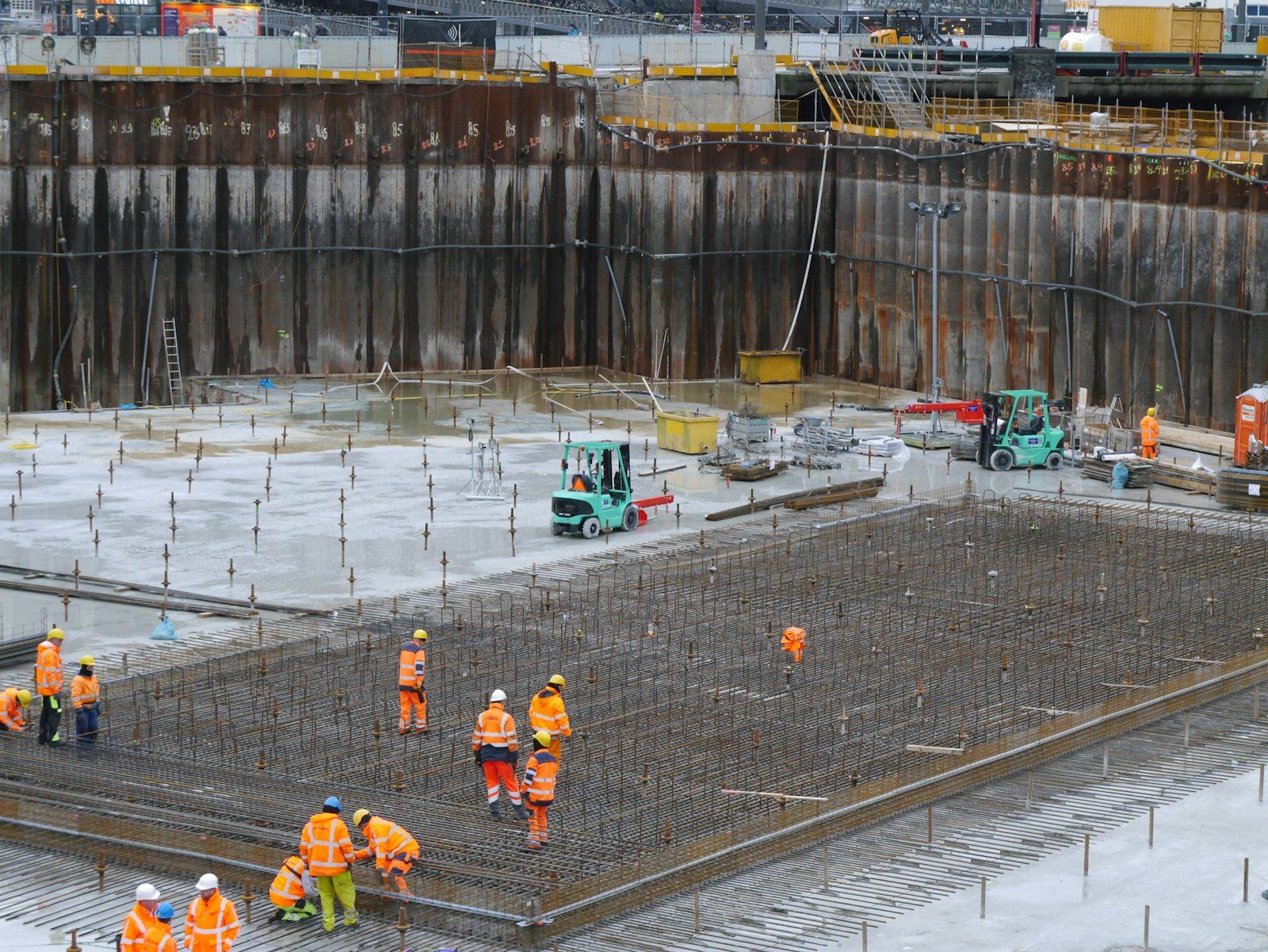
If the grade line along your walk looks wrong from the sidewalk, that's the panel we lift.
Most of these you can spot without leaving the sidewalk. A front walk where one panel dips and still holds water three days after a storm. A garage apron with a dark open seam where it dropped away from the slab beside it. A porch step that used to sit even with the walk and now has an extra inch of rise on it.
Those are settlement signs, and slurry lifting is usually the cheapest way out. The method is old and it still works. We drill a pattern of ports through the slab, pump a sand and cement mix underneath until the panel floats back up against its neighbor, then trowel the ports closed. One panel or twenty. Most of it wraps inside a day, and nothing goes in a dumpster.
Water tells on a slab before anything else does. A panel that dips even a half inch keeps a puddle after every summer storm, and by January that puddle is ice your mail carrier learns to step around. Look at the joints too. When one side of a joint casts a shadow line the others don't, that side dropped.
Gates are another giveaway. A back gate that used to swing clean and now scrapes says the walk under it came down. So does a shed door that binds, a sprinkler head standing proud of a settled panel, and a downspout kick-out spilling onto concrete that tips the wrong way. None of that needs a tape measure. You just have to stop and look.
Almost every lift we do traces back to a trench or a downspout. Utility work runs under front walks and along alleys all over this city, and trench backfill compacts on its own schedule for years afterward. The slab bridges the soft spot until it can't. Add a gutter that dumps at the corner of the house and you get a void carved out from below, one storm at a time.
Vintage matters. Around Park Hill, Wash Park, and University Hills we're usually lifting original flatwork that has been riding a slow settlement curve since before anybody reading this owned the place. In Central Park and the scrape-and-rebuild pockets of Berkeley and Sloan's Lake, the panels are newer and the culprit is fresh backfill that never got compacted in lifts. Different story, same droop.
| What you can see | What happened underneath | Does slurry fix it |
|---|---|---|
| One walk panel dips and holds water | Base washed out, or the trench under it kept consolidating | Yes. Textbook lift. Drill, pump, set it back flush to its neighbor. |
| Dark open seam at the garage apron | The apron settled and pulled down off the garage slab | Yes, if the apron is otherwise sound. We raise it and reseal the joint. |
| Slab now tips back toward the house | Backfill along the foundation is still settling | Yes, and this one jumps the line. Water at the wall beats a trip hazard for urgency. |
| Sunken panel with two cracks across it | The slab broke as its support disappeared | Often. Broken concrete lifts in pieces. Two cracks is a yes, five is usually a no. |
| Whole run slopes evenly downhill | Nothing. That's the grade it was poured on | No. There's nothing to raise. Somebody built it that way on purpose. |
| Crumbling edges, flaking top, panel still flat | Surface wear from deicer and freeze cycles | No. Lifting corrects grade, never the top half inch. |
Take the picture from the spot where the dip first caught your eye. We'll tell you whether that panel is a lift candidate.
Here's the honest limitation. Slurry is heavy. We're filling a void with sand, cement, and water, and that material stays down there as added dead load on the same soil that already gave way once. On firm subgrade that's fine and it has been fine for decades. On soft organic fill, or over a void we can't account for, adding weight is asking for a second visit. Those jobs get polyurethane or a new pour, and we'll say which.
Access is the other constraint. The rig parks where a truck can park, and we run hose from there, so an alley-side patio behind a Highlands bungalow is a hose-length question before it's a concrete question. We work that out before you're on the schedule. Season runs roughly March into December here. Frozen ground can't be pumped, and a slurry placed into a frozen void does nothing useful.
Still unsure about something?
Call the crew at (303) 569-4046 and we will talk it through.
Get a free, no-obligation estimate from a crew that knows Colorado soil, Colorado weather, and how to finish concrete that lasts.
Accessibility
Adjust the site to fit how you read and browse. Your choices are saved on this device.