
Basements and slabs that are level, sound, and code-compliant.
A foundation is the one part of a house you cannot easily get to once the build is done. Everything above it depends on it sitting level, carrying its load, and resisting whatever the ground underneath decides to do. We design and pour residential foundations for Front Range homes: full basements, slab-on-grade, footings, and stem walls. With a structural engineer on staff, the foundation is built to the soil report and the load it has to carry, not a rule of thumb copied from a flatter part of the country.
Around the Denver metro and up and down the Front Range, the ground is the whole problem. A lot of this region sits on expansive clay that swells when it gets wet and shrinks when it dries out. That movement can lift a slab, crack a wall, and rack a frame if the foundation was not built to resist it. Getting the base, the reinforcement, the drainage, and the concrete mix right is what keeps the house above it square for the long haul. That is the work, and it has to be right the first time.
Springs elevation brings strong freeze-thaw and some notoriously expansive soils. We engineer foundations and flatwork accordingly. For residential foundations, that local knowledge is exactly what protects your investment. We plan the base, drainage, reinforcement, and finish around the conditions on your Colorado Springs property, not a generic detail.
We serve every part of Colorado Springs and the surrounding area, including Briargate, Broadmoor, Old Colorado City, Flying Horse, and more. Wherever you are in El Paso County, the crew shows up with the same standard.
At roughly 6,035 feet, Colorado Springs gets intense high-altitude sun and a freeze and thaw cycle that is hard on any concrete poured without care. For foundations, that means air-entrained mixes, deliberate curing, control joints cut on time, and a base prepared for the expansive clay under your property. It is the difference between work that holds for decades and work that starts failing by the first or second spring.
This is the honest concern with any Front Range foundation, so we will not talk around it. Expansive clay can exert real upward pressure when it takes on water, and a foundation that ignores it will move. No contractor can promise the ground will never shift. What we can do is build so that movement does not wreck the structure. That starts with the soil report, which tells us what we are actually sitting on, and a foundation engineered to match it. Depending on the report that can mean a structural slab over void space, deepened footings, heavier reinforcement, or drilled piers carrying the load past the active clay. We pair that with drainage that moves water away from the house, because dry clay is stable clay. The goal is a foundation that resists the soil instead of fighting it and losing.
A lot of foundation problems trace back to a design that was never matched to the site. Having a structural engineer on staff means the foundation under your home is sized to the soil report and the load above it before a single form goes up. The engineer reviews the geotechnical findings, specifies the footing dimensions, the reinforcement schedule, and the foundation type that fits your lot, then stamps it for the permit. That is a real difference on the Front Range, where two lots on the same street can have different soil behavior. It also means that when an inspector or a lender wants to see engineered drawings, they exist. You are not getting a generic foundation poured to whatever the crew did last week. You are getting one designed for the dirt under your house.
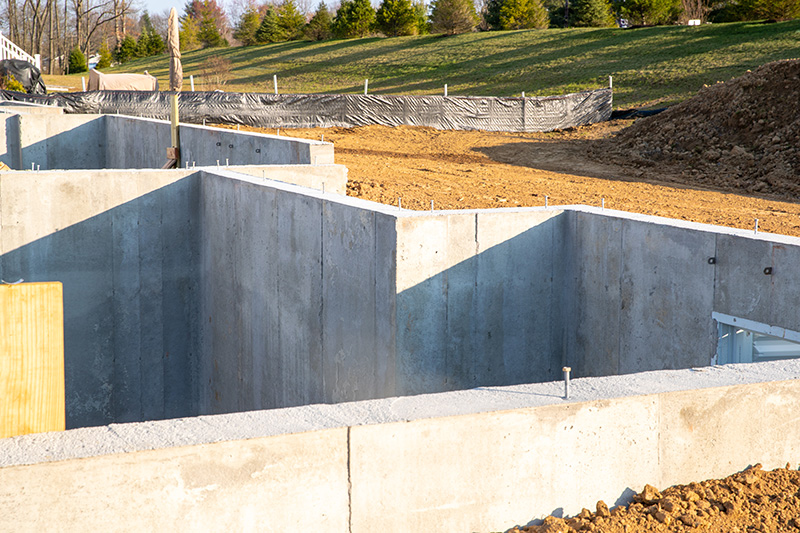
The footing is the wide base that spreads the structure's weight into the soil, and the stem wall carries the load from that footing up to the framing. Both have to be poured below the local frost depth so the ground freezing and thawing through a Colorado winter cannot lift them. Pour a footing too shallow and the first hard freeze starts working it loose. We set the footings to depth, tie in the reinforcement, and pour stem walls plumb and true so the framing above sits square. Anchor bolts and any required hold-downs get placed before the concrete sets, not drilled in later. When the foundation is the transition between the ground and the house, every part of that transition has to be right, because the framing crew inherits whatever we leave them.
A full basement gives you finished or unfinished living space below grade, and it asks for tall, reinforced walls that resist the lateral pressure of the soil pushing in from the sides. Drainage and waterproofing around those walls matter as much as the concrete itself, since standing water against a wall is what drives both leaks and clay movement. Slab-on-grade puts the floor and the foundation in one pour, which is efficient when the base prep, the vapor barrier, and the reinforcement are handled correctly. We build either one to resist the soil movement that defines construction here, with a compacted base, the right reinforcement, control joints, and air-entrained concrete that stands up to the freeze-thaw cycle. The right choice depends on your plans, your lot, and what the soil report says is smart.
Every Colorado Springs job starts with a free, written estimate and a structural engineer on staff for the work that needs one. Licensed, bonded, and insured, with finishes from a clean broom texture to stamped, colored, and sealed.
You always know what is happening and what it costs before we mix a single yard. Here is the path from first call to final walkthrough.
We visit the site, measure, check drainage and soil, and hand you a clear written quote. No charge, no pressure.
We set the grade, thickness, reinforcement, and finish. Structural work gets engineered and permitted.
Forms, rebar, and a clean pour. We screed, float, and finish to the texture you picked, then cut control joints.
You can walk it in 24 to 48 hours. We walk the job with you and explain how to care for it through the first winter.
Still unsure about something?
Call the crew at (303) 569-4046 and we will talk it through.

Get a free, no-obligation estimate from a crew that knows Colorado soil, Colorado weather, and how to finish concrete that lasts.
Accessibility
Adjust the site to fit how you read and browse. Your choices are saved on this device.