
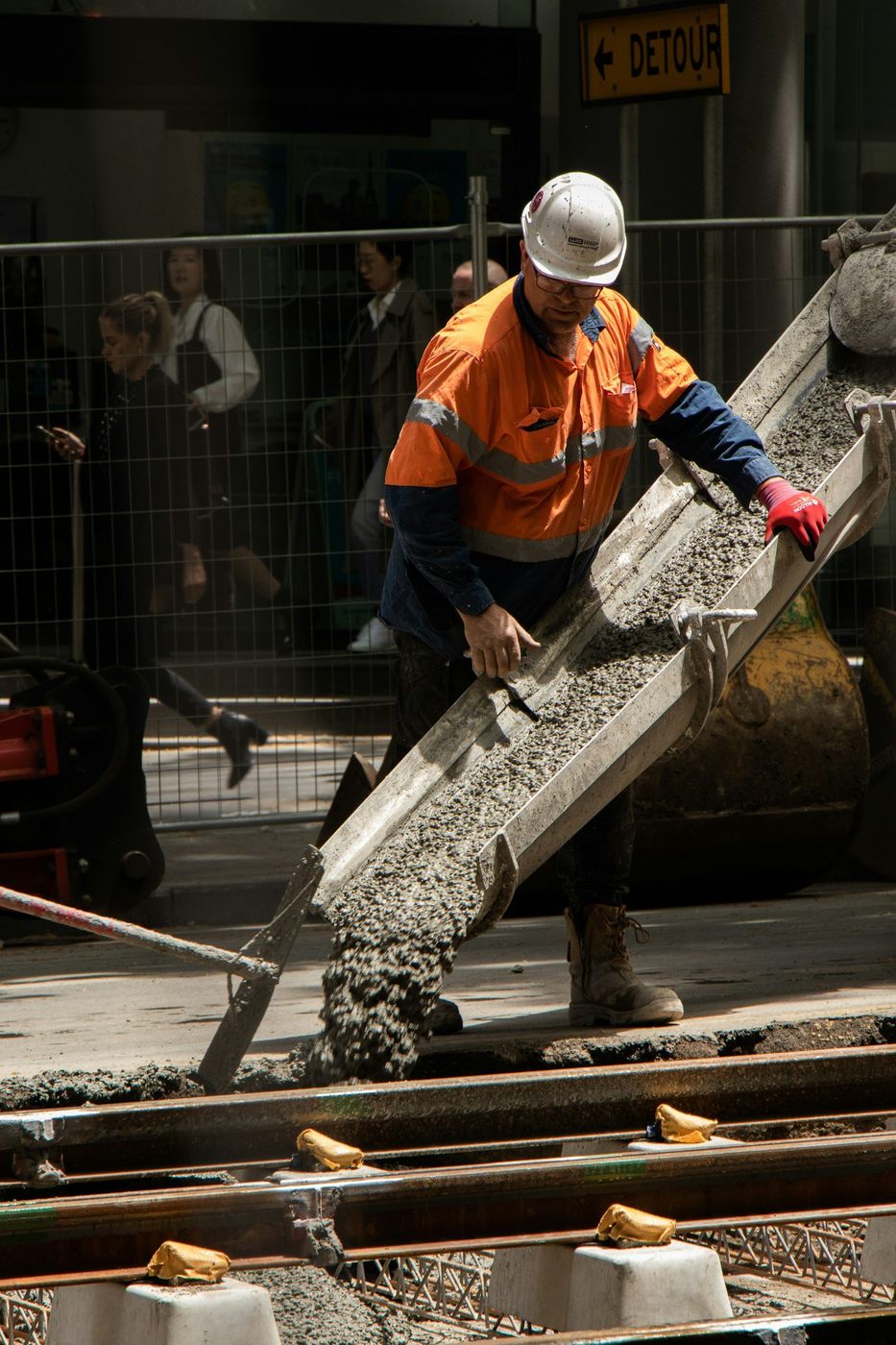
A pond floor is the only slab we pour that gets loaded from both sides.
Every other slab we build has water on top and dry ground below. A pond floor has water above it and, at certain times of year, water underneath it too. That changes the whole design. The concrete has to resist pressure pushing down when the pond is full and pressure pushing up when it's low, all while the soil below swells, shrinks, freezes, and thaws through a normal Arapahoe County year.
So we start at the bottom and work up. Everything visible in a finished water feature, the boulders, the falls, the plantings around the edge, sits on decisions made in a trench nobody will ever see again. Ponds go into back yards across Homestead and Piney Creek and the ones that stay watertight are the ones where somebody spent real money on the part below the waterline.
Excavation goes deeper than the finished shell, because there's a stack of material to build back up. Native soil gets cut to a firm, uniform bearing surface. Soft pockets get dug out and replaced rather than compacted in place, since a soft spot under a rigid shell is a crack waiting for a reason.
Above that goes free-draining aggregate, compacted in lifts, thick enough to break the connection between the shell and whatever the soil wants to do. In that base we set an underdrain: perforated pipe in gravel, sloped, running to daylight or a low point where water leaves under its own power. That pipe is the best insurance a concrete pond can carry.
Then steel, sized by the engineer, chaired so it sits in the concrete instead of on the base, continuous through the corner where floor meets wall. That corner is where a pond either holds water or doesn't, and it gets a waterstop cast in if the pour has to be staged.
Ask ten people why a concrete pond leaks and nine will say the concrete cracked. True, but incomplete. Concrete cracks because something moved it, and with a pond the mover is almost always the ground.
Frost is the obvious one. A shell on wet, fine-grained soil gets heaved unevenly when that soil freezes, and a rigid box doesn't tolerate being lifted at one corner. Dry base doesn't heave the way saturated base does, which is what the drainage is for.
Uplift is the less obvious one. Drain the pond in the fall and you've removed thousands of pounds of ballast while the ground around it may still be full of water. The shell wants to float. Same physics that lifts swimming pools, and it's why we build an underdrain.
Then simple settlement: fill nobody compacted, a trench crossing the footprint, an old stump hole. Any of those gives way under one section and the shell spans until it can't.
Before anyone quotes you a rebuild, let us look. Plenty of leaks are a joint, a penetration, or a liner detail, not the whole shell.
| Condition under the pond | What it does to the shell | How we build for it |
|---|---|---|
| Uncompacted fill from an old grading job | One section settles, the floor cracks across it | Dig it out and replace with compacted structural fill |
| Fine soil that holds water and freezes | Uneven heaving at the edges, cracks that open in winter and close in spring | Free-draining base and an underdrain that keeps the subgrade from staying saturated |
| Perched water after spring melt | Uplift pressure on an empty or low shell | Underdrain to daylight, real wall thickness, a winter plan |
| A utility trench crossing the footprint | A crack following the trench line through the floor | Recompact in lifts, then carry reinforcement across it |
| Yard runoff aimed at the pond | Silt, debris, and saturated soil outside the walls | Regrade so surface water goes around, not in, plus an overflow that works |
Watertight concrete is mostly about cure. We keep a fresh shell damp and covered for the better part of a week, because concrete that dries fast at the surface shrinks, and shrinkage is where cracks come from. That week is not a place to save time.
Season runs roughly April through October at this elevation, and early fall is lovely for this work. Warm days, cool nights, less risk of a hard afternoon storm landing on a fresh surface. We don't pour a shell onto frozen ground and we don't rush a cure in freezing weather.
After it's filled, expect a break-in period. Fresh concrete pushes pH up, so a pond gets rinsed, filled, and cycled before anything living goes in, with the water tested rather than guessed at. Through the first winter, either keep it running with an aerator to hold an opening in the ice or shut it down the way we show you.
Still unsure about something?
Call the crew at (303) 569-4046 and we will talk it through.

Get a free, no-obligation estimate from a crew that knows Colorado soil, Colorado weather, and how to finish concrete that lasts.
Accessibility
Adjust the site to fit how you read and browse. Your choices are saved on this device.