
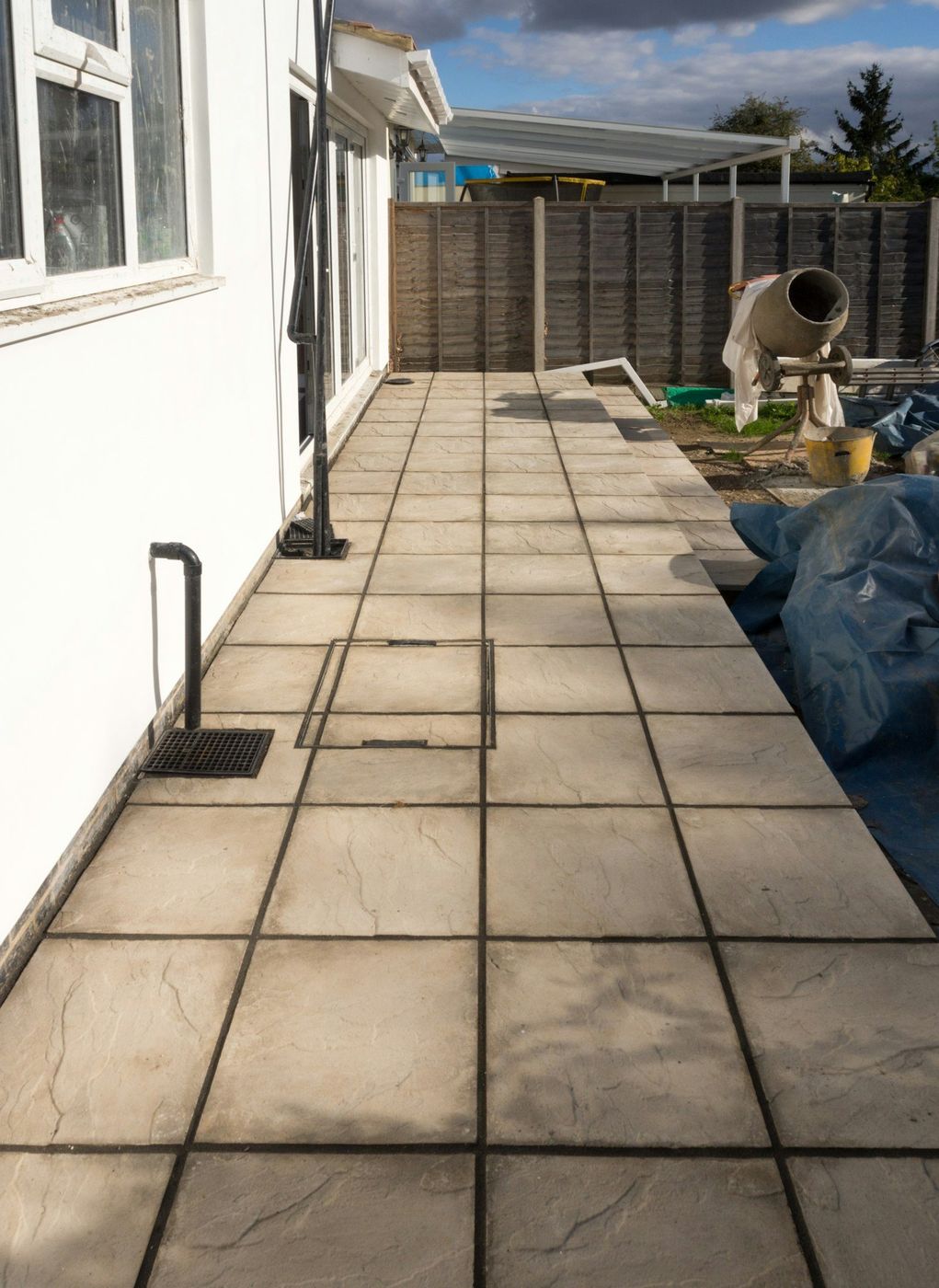
Traction underfoot, water moving away from the coping, and a joint at the pool edge that lets the deck move on its own.
You can read a failing pool deck from the gate. Look at where the water goes after somebody climbs out: if the wet footprints run toward the pool instead of away from it, the deck is pitched backward and every rainstorm has been washing grit and lawn chemicals into your water for years. Look at the line where the concrete meets the coping. A dark open gap there means the joint has given up.
Then look at the color. A deck in the splash zone that's gone chalky and pale, with tiny pits you can feel through a bare foot, has been losing its surface to pool chemistry and freeze-thaw at the same time. None of those symptoms are cosmetic. Each one is the deck telling you which part of the build was skipped, and each one gets worse on its own schedule.
Start with chemistry. Splash-out carries chlorine or salt onto the surface, it evaporates fast in this dry air, and the residue concentrates right where it landed. Do that a few thousand times and the paste at the top of the slab starts giving way. Add a winter at 6,450 feet, where a sunny February afternoon melts the snow on the deck and a clear night refreezes it, over and over, and any water that soaked into a weakened surface expands inside it.
Then there's the terrain. Pools on these wooded, hilly lots almost always sit on a graded pad with a slope above them, which means the deck isn't just handling its own rain. It's catching whatever runs down the hill. In The Village at Castle Pines we've walked decks where the surface pitch was fine but the yard above delivered more water than any deck drain could take. Fixing that is landscape grading and drainage, not concrete, and we'll say so.
| Finish | Traction when wet | What you should know |
|---|---|---|
| Medium broom | Very good | The workhorse. Cheapest to pour, easiest to repair, and it never gets slick. Plain looking, which some owners mind. |
| Exposed aggregate | Very good | Stone at the surface gives grip and hides staining. Rougher on knees and bare feet, and it needs sealing to keep the matrix intact. |
| Textured or knockdown overlay | Good | Bonded topping over sound concrete. Great for rescuing an ugly deck. It will not fix a deck that's moving or pitched wrong. |
| Stamped with a grit additive | Fair to good | Only acceptable around water if the sealer carries a nonslip additive. Reseal on schedule or it turns glassy. |
| Hard troweled or polished | Poor | We don't put it around a pool. Looks sharp dry, dangerous wet, and it belongs indoors. |
We'll shoot grades around the whole pool and show you the numbers before you decide on repair or replacement.
Pitch comes first. Roughly a quarter inch to the foot, moving away from the water, everywhere. On a deck hemmed in by a house on one side and a slope on the other, that fall has to go somewhere, which is where deck drains earn their keep. A channel drain along the low edge, tied to a solid line that daylights well away from the pool shell, does what surface slope alone can't.
Second, the joint at the coping. The deck and the pool structure are separate things and they move separately. We keep a compressible expansion joint between them, full depth, sealed at the top with a flexible sealant that gets replaced when it ages out. Concrete poured tight against a bond beam pushes on it every hot afternoon, and that's how coping stones pop loose.
Third, jointing and reinforcement in the deck itself. A pool surround is an odd shape with a big hole in the middle, so control joints have to radiate from the corners of that hole where cracks want to start anyway. Steel on chairs, joints sawed the same day the deck is poured, spacing matched to the thickness. Do those and the cracks land in the lines you chose.
Owners call about the gray blotches by the steps and want to talk about color. We end up talking about drainage, because that blotch is almost always where water has been sitting for years.What the crew sees on site
Still unsure about something?
Call the crew at (303) 569-4046 and we will talk it through.

Get a free, no-obligation estimate from a crew that knows Colorado soil, Colorado weather, and how to finish concrete that lasts.
Accessibility
Adjust the site to fit how you read and browse. Your choices are saved on this device.