
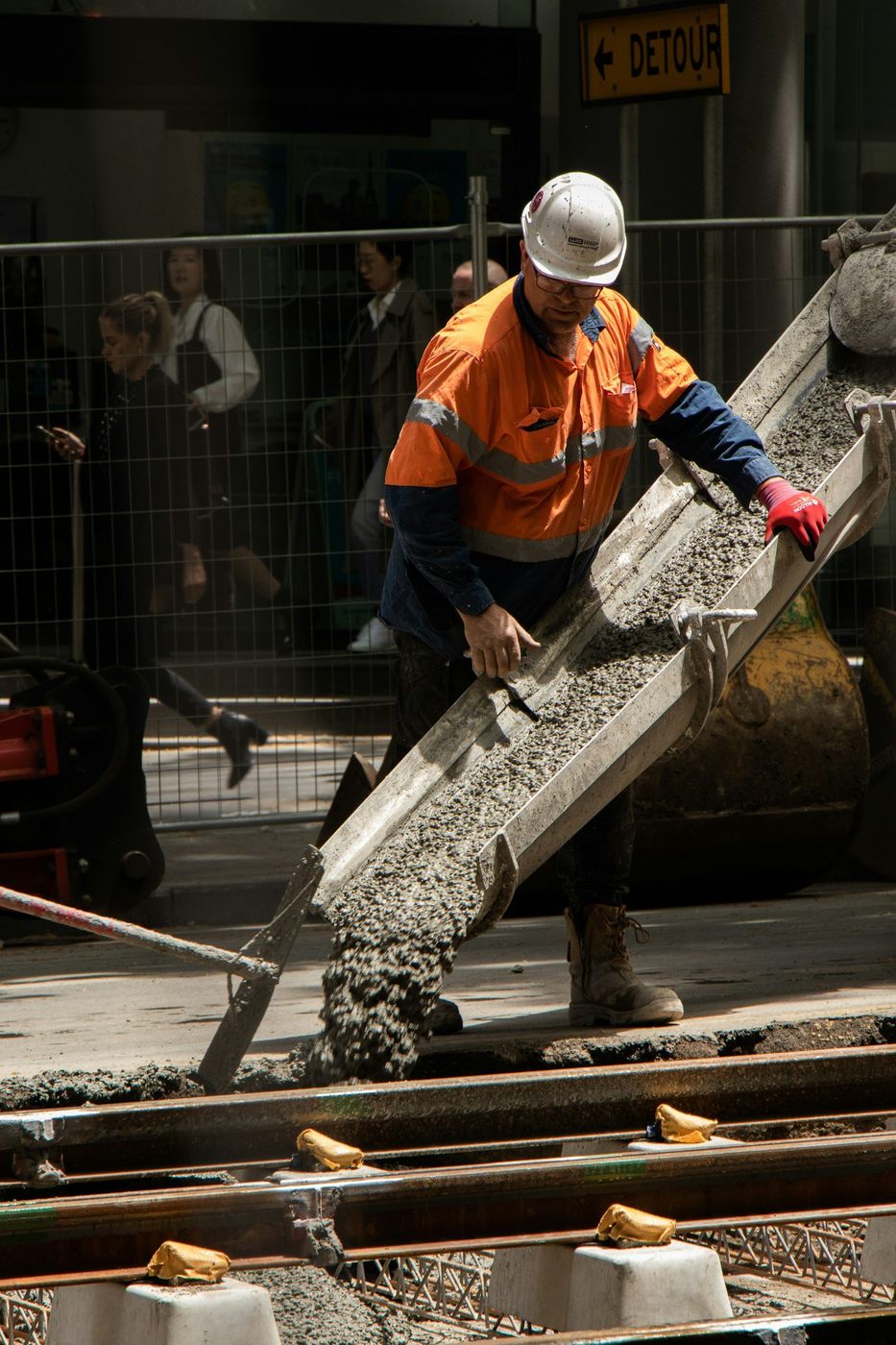
Lines cut into a slab on purpose, laid out before the truck ever backs down the drive.
Scoring is the cheapest design decision in concrete and the easiest one to get wrong. You're cutting lines into a slab to give it scale and rhythm, so a big gray field reads as a floor made of parts instead of one enormous pancake. Done well nobody thinks about it. Done carelessly you get a pattern that fights the house, or slivers of concrete in a corner that crack out within two years.
The whole thing lives or dies on pour day, and mostly on the hours right after the finishers step off. So here's how that day runs on one of our jobs, start to finish.
Truck backs in early. We place, screed, and bull float, and the surface goes through its stages while somebody watches the clock and the sky. Bleed water rises and has to leave on its own before anybody touches the top; working a wet surface is how you build a weak skin that flakes off in a few winters.
Then the fork in the road. If the pattern is getting tooled, that happens while the concrete is still plastic. A hand groover runs along a straightedge and presses a rounded line into the surface, softer and more traditional looking, and the finisher comes back after with a broom or a trowel to blend the edges. If the pattern is getting cut, we wait. An early-entry saw goes in a few hours after placement, once the slab can hold an edge but before it's hard enough to chip. Miss that window in either direction and it shows.
Last comes the finish texture, the joint cleanup, and cover if weather is coming. Long day. The lines are permanent, which is why nobody rushes them.
| Method | Timing | What you get |
|---|---|---|
| Hand-tooled groove | While the concrete is still plastic, same crew, same hour | Soft rounded edges with a hand-made look; shallow, so decorative only |
| Early-entry saw cut | Roughly one to four hours after placement | Crisp narrow lines that can double as real control joints when cut deep enough |
| Conventional wet saw | Next day, once the slab has strength | Wider kerf, very clean, but you're racing the slab's own urge to crack first |
| Dry cut on an old slab | Any time, on concrete that's fully cured | Scoring an existing patio for pattern or ahead of a stain job; dusty work, so we run vacuum shrouds |
Send the layout or a photo of a floor you liked. We'll tell you how it lands on your dimensions before we quote it.
This is where most confusion lives. A control joint is a structural device. It's cut about a quarter of the slab's depth so the concrete has a weak plane to crack along, out of sight, under the line. A decorative score is shallow, an eighth to three sixteenths of an inch, and it does no structural work whatsoever.
Good layout makes them the same lines wherever it can. We set the pattern so the joints the slab needs fall on the grid the design wants, then cut those deep and the rest shallow. When a client's pattern can't accommodate the joint spacing a slab requires, we say so and we adjust the pattern, because a slab will crack on its own schedule if we don't give it permission somewhere sensible. Diamonds on a forty-five degree turn look sharp and they complicate this considerably. Large-format grids and ashlar layouts are friendlier to the engineering.
I've never had a client complain about a pattern being too simple. Every complaint I've heard was about lines that didn't line up with something in the house. Get the first chalk line right and the rest just follows it.The crew lead's read on it
Timing windows shrink up here. A dry, windy afternoon at 6,450 feet stiffens a slab well ahead of what the thermometer suggests, and the saw window can close an hour early without warning. So we pour in the morning, and we never book a scoring job on a day the crew is already stretched. Rain is the other risk, because a shower during finishing softens the exact layer every line has to run through.
Scoring season here matches flatwork season: late April through October, with September as the calm favorite. We can cut and stain an existing slab indoors any month of the year.
Around Castle Pines, most scored work is entry courtyards and covered patios in The Village at Castle Pines and Daniels Gate, where a plain slab would look undersized against the house. Castle Pines North sends us cured slabs to score and stain as a refresh, and in Lagae Ranch and BellaMesa we're usually scoring new pours where the pattern gets planned before the concrete is ordered.
Still unsure about something?
Call the crew at (303) 569-4046 and we will talk it through.

Get a free, no-obligation estimate from a crew that knows Colorado soil, Colorado weather, and how to finish concrete that lasts.
Accessibility
Adjust the site to fit how you read and browse. Your choices are saved on this device.