
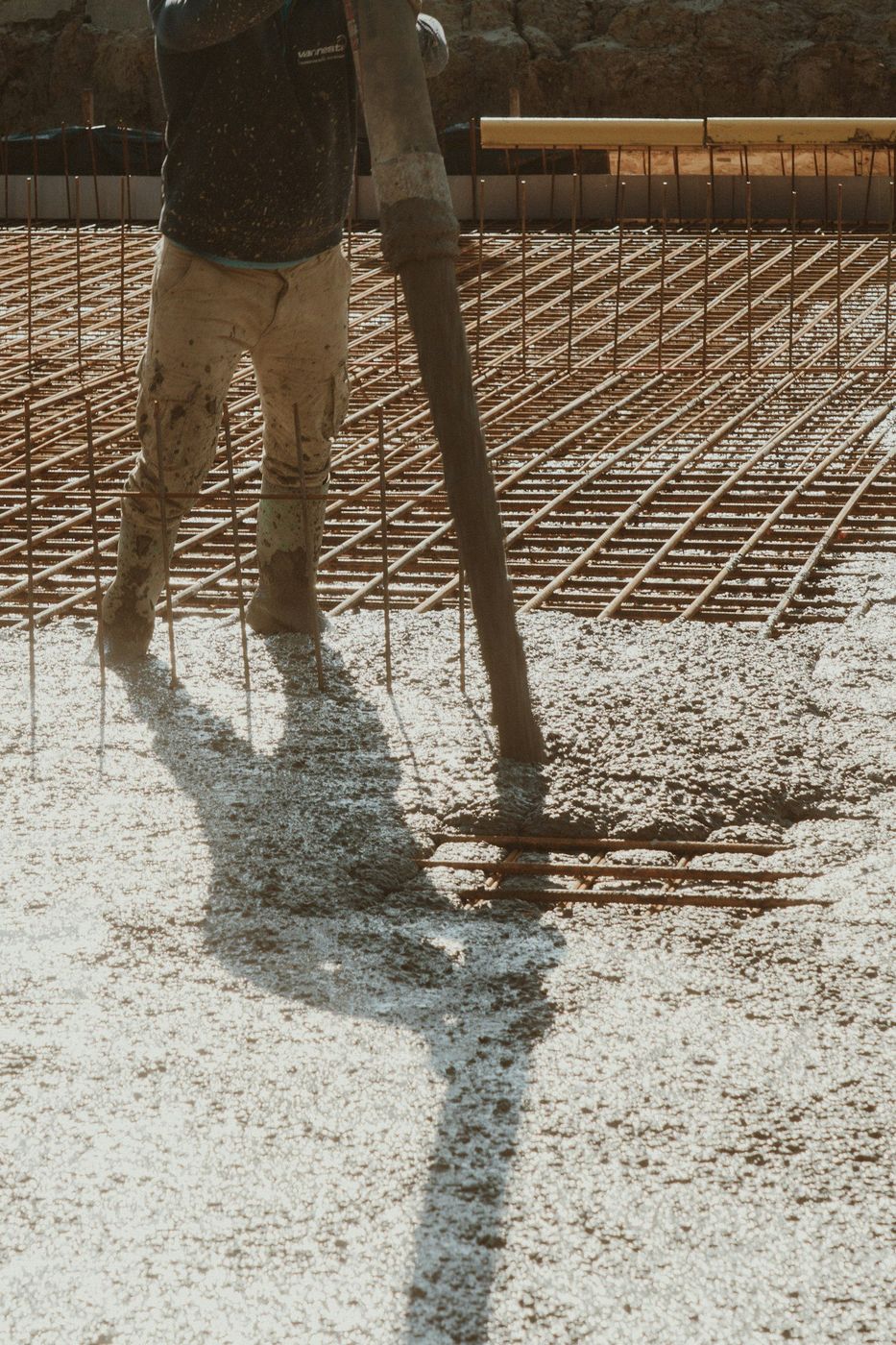
The broom, the trowel, and the float are the last hour. The base is the other ninety percent.
Everybody shops finishes. Which texture, which color, what it looks like wet. Fair enough, since that's the part you see. But we'd rather spend the first meeting under the slab than on top of it, because the finish is the last hour of a job whose outcome was decided days earlier by a plate compactor.
Castle Pines sits on wooded, tilted ground in Douglas County, and the lots here rarely hand you a flat, uniform pad to work from. Cut and fill on a hillside means part of your slab may sit on native soil and part on material somebody trucked in. That difference is invisible once concrete covers it. It is not invisible three winters later.
We dig to firm ground, not to a depth on a form. If the excavation finds soft or organic material, it comes out and gets replaced with road base compacted in lifts, four to six inches at a time, each one run with the plate before the next goes down. Dumping eight inches of gravel and passing over it once looks the same and performs nothing alike.
Drainage next. On these slopes the question is always where water goes when the snow lets loose in March or when a summer cell parks over the ridge for twenty minutes. Slab surfaces get pitched away from the house, roughly an eighth of an inch per foot, and we look at what's uphill of the pour before we set a single form board. A patio that catches hillside runoff and holds it against a foundation is a bad patio no matter how nicely it's troweled.
A broom finish is the workhorse and there's nothing second-rate about it. Drag direction matters: the broom gets pulled across the way people walk, so ridges catch a shoe instead of channeling it. Light broom for patios, heavier for a sloped drive.
Hard trowel belongs indoors. It closes the surface tight and dense, which is exactly what you want in a garage or a shop floor and exactly what you don't want outside, where a sealed-up top layer and freeze-thaw make a bad pair. Float finish, that open sandy texture, works on covered porches and pool surrounds where bare feet happen. Salt finish gives a pitted look that sheds water and hides dirt. And rock salt in a climate that freezes twenty times a winter is a debate we usually lose on purpose, since those little craters hold water.
We'll probe the base and look at how water moves across your lot before we quote a texture. No charge for the visit or the opinion.
| Location | Finish we use | Why that one |
|---|---|---|
| Sloped driveway or approach | Medium broom, pulled across the slope | Tire grip on ice, and the ridges shed meltwater sideways instead of down the wheel track |
| Garage or shop floor | Steel trowel, hard and dense | Sweeps clean, resists oil soaking in, and takes a coating later if you want one |
| Covered porch or pool surround | Float or light broom | Open texture with bite for bare feet, and it doesn't glare in afternoon sun |
| Dining and furniture patio | Fine broom or a light knock-down | Chairs slide without catching, and it still isn't slick when a storm blows through |
| Front walk and steps | Broom with a hand-tooled edge | The edge detail is what makes a walk look finished; treads need grip more than looks |
Anybody can put a nice broom on wet concrete. The trick is having a slab that still deserves it in ten years. When I look at a failed pour, I've never once thought the problem was the texture.From the crew lead on these jobs
Finish quality tracks the weather more than most homeowners realize. A hot, dry, breezy afternoon at 6,450 feet pulls water out of a slab surface fast, and a crew chasing a stiffening surface produces a texture that's inconsistent from one end to the other. So summer pours start at sunrise, we keep evaporation retardant on the truck, and we're honest when the forecast says wait a day.
Late April through October is the working season for exterior finishes, with September and early October the best of it. Cold-weather pours are possible with heated water, non-chloride accelerators, and insulated blankets, and we do them, but we won't place concrete on frozen ground and we won't promise a decorative texture in deep winter.
Around town, Castle Pines North and older parts of The Village at Castle Pines send us replacements where the original base was thin and the surface has scaled. Lagae Ranch, Daniels Gate, and BellaMesa are newer, so those calls run toward additions: extending a patio, adding a walk, matching the builder's texture. That matching is real work, and we pour a sample panel first.
Still unsure about something?
Call the crew at (303) 569-4046 and we will talk it through.
Get a free, no-obligation estimate from a crew that knows Colorado soil, Colorado weather, and how to finish concrete that lasts.
Accessibility
Adjust the site to fit how you read and browse. Your choices are saved on this device.