
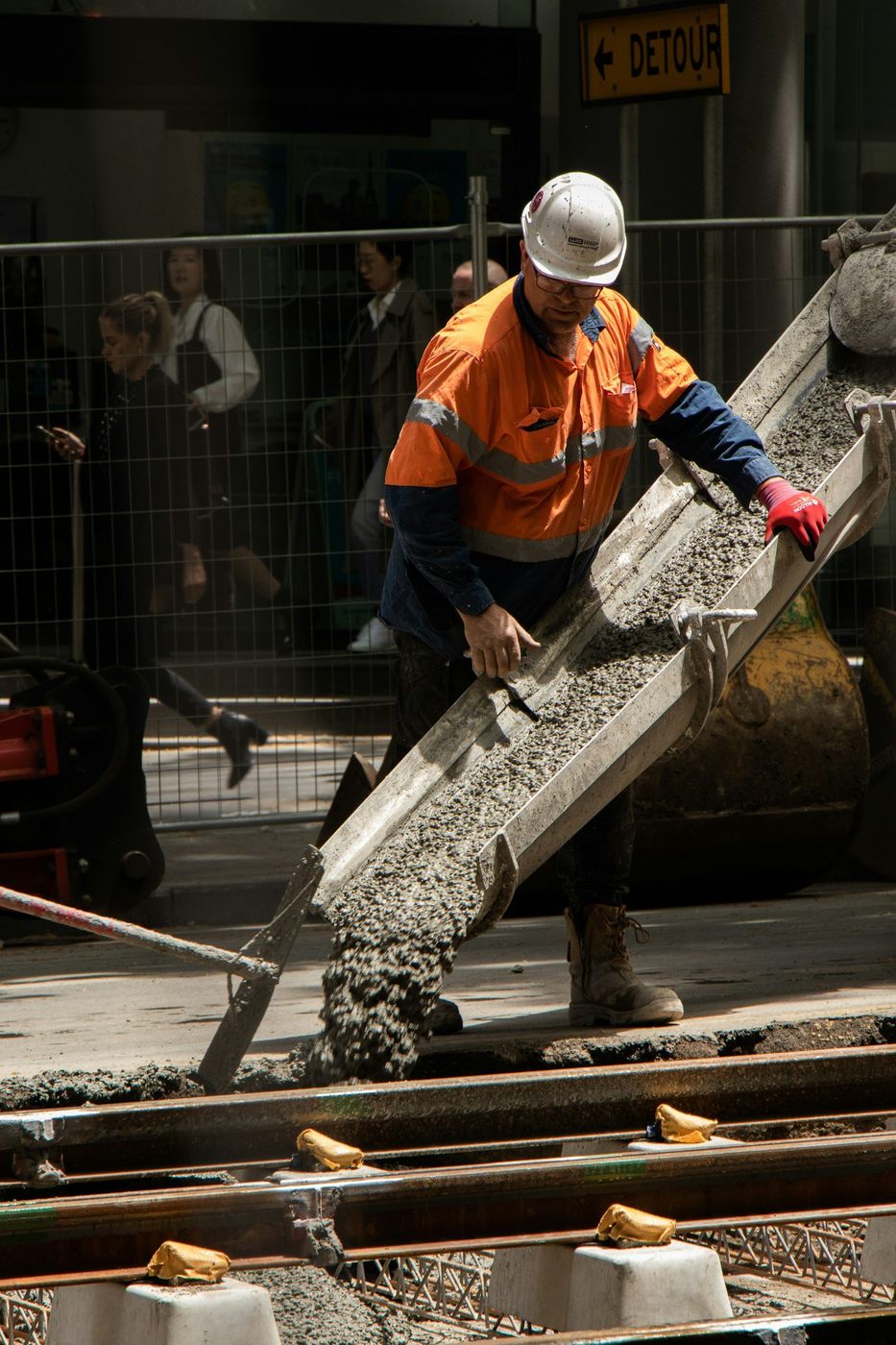
The argument is never whether to pour concrete at the enclosure. It is how far out the concrete should go.
Almost nobody debates the pad itself anymore. Put a heavy container on asphalt and the asphalt loses, every time, and most property managers have already learned that at least once. The real decision is where the concrete stops. Under the container? Out through the gates? All the way back to the drive aisle where the truck starts its reverse?
That choice decides whether you fix this once or keep fixing the seam between the new concrete and the old asphalt for the next decade. We build enclosure pads, approach aprons, and containment slabs for commercial and association property across Arvada, and this is the conversation we have on nearly every site visit.
Think about what actually happens at pickup. The truck backs in, sometimes a long way, sometimes with a correction or two. It stops. Forks go under the container, and the entire loaded weight transfers to the front axle and the outriggers, which are sitting well forward of the container itself. The container lifts, tips, comes back down hard. Then the truck pulls forward under load.
Notice how much of that happens outside the enclosure. If the concrete covers only the container footprint, the highest loads of the cycle land on whatever is in front of the pad. That is why a sound pad so often sits in the middle of destroyed pavement.
The second half of the argument is water. An enclosure collects a lot of it: rain off the lids, meltwater from the pile the plow pushes against the walls, and whatever leaks out of the container. Where that water goes decides whether the base under your new pad stays dry. A slab that drains toward the gate opening and out across the asphalt gives you a soft spot at the transition within a couple of seasons.
| Scope | When it is the right call | Where it bites you |
|---|---|---|
| Concrete under the container only | Light rear-load service, a small container, and sound pavement in front of the gates | The outriggers and front axle land on asphalt. Expect to be back at that seam |
| Pad plus an approach apron through the gate opening | Front-load service on most retail and association properties. This is the common answer | Nothing, if the apron is long enough. Cutting it short to save a few feet undoes the whole point |
| Pad, apron, and the full path the truck reverses over | Tight sites where the driver backs a long way, or a route with multiple containers in a row | Bigger scope and a longer closure, so it wants to be coordinated with other lot work |
| Pad with an integral containment curb and a defined outlet | Restaurants, grocery, medical, or anywhere the container leaks and the runoff has to be controlled | Adds a drainage element that needs cleaning. Neglected, it holds water instead of moving it |
Send a photo of the enclosure and tell us who hauls for you and how often. We will mark the footprint we would build and tell you what each version buys.
Enclosure pads are small, so weather is less of a limit here than on a lot. Cold work gets warm batch water, a chloride-free accelerator, and insulation, and an area this size is easy to protect overnight. The one hard rule stays: no placing on frozen ground, and no compaction of frozen material pretending to be base. If the frost is deep and the excavation is deep, we will wait.
What does change with the season is service. Winter pickups get harder to reroute, snow piles occupy the space we need for staging, and meltwater keeps the excavation wet. Spring through fall makes the logistics simpler even though the concrete does not care much. Plan on a temporary container somewhere else on the property for the closure, and get that arranged with your hauler before we mobilize rather than during.
Property type shifts the answer too. Shared enclosures behind older buildings near Olde Town are tight, often serving several tenants, with barely room for the truck to line up, so those sites usually need the full reversing path in concrete. Newer commercial pads and association amenity areas serving Candelas, Leyden Rock, and Whisper Creek have space and geometry on their side, but the ground is graded fill and the base work matters more than the layout. Established properties around West Woods most often need the apron extended, since the original pad was drawn to the enclosure walls and nothing else.
Look at where the front tires of the truck stop, not at where the container sits. Nine times out of ten the broken pavement starts right at that line, and the pad behind it is fine.The crew lead's read on it
Still unsure about something?
Call the crew at (303) 569-4046 and we will talk it through.

Get a free, no-obligation estimate from a crew that knows Colorado soil, Colorado weather, and how to finish concrete that lasts.
Accessibility
Adjust the site to fit how you read and browse. Your choices are saved on this device.