
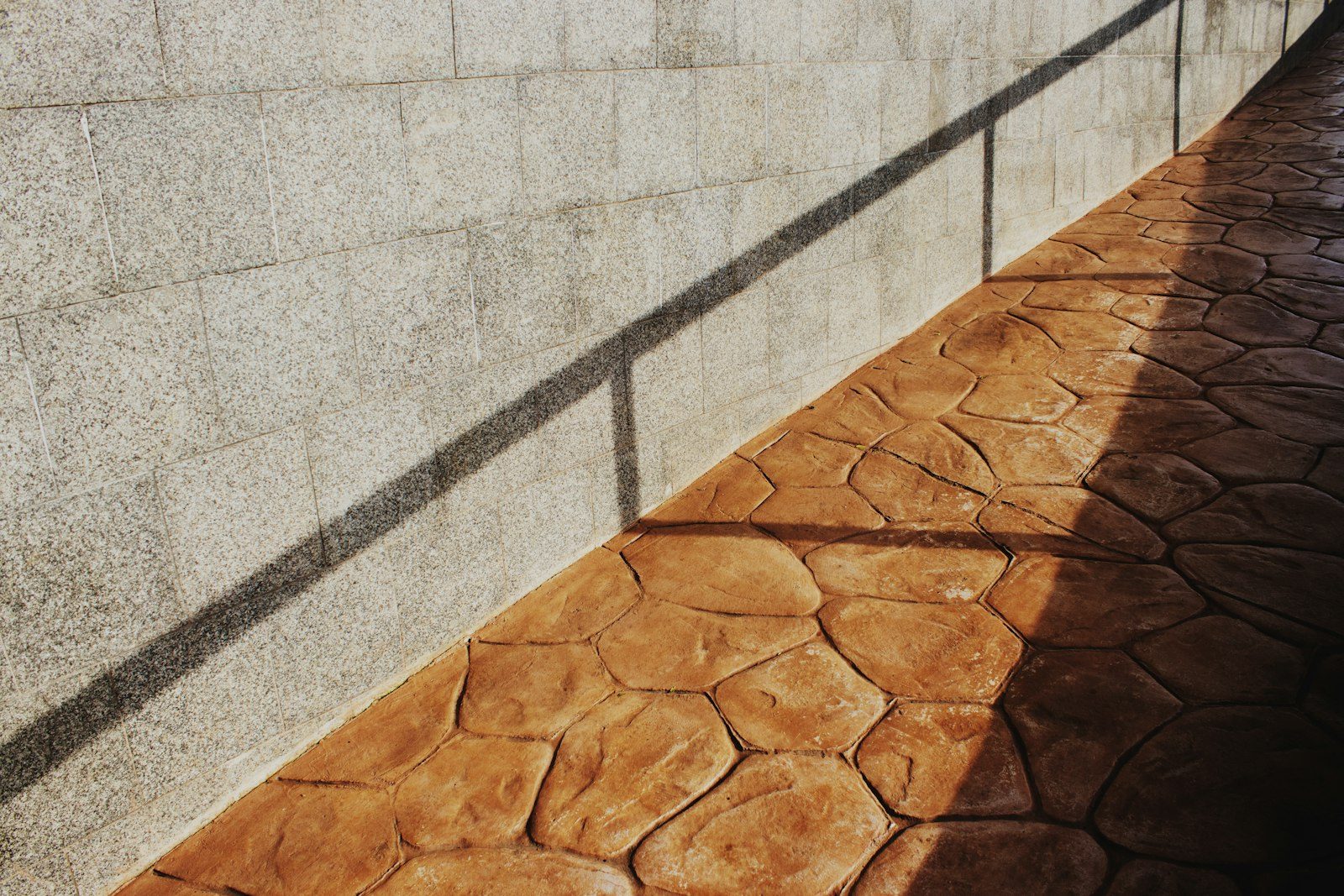
The saw doesn't care how old your slab is. We do, because we don't know how thick it is until we go look.
Two scoring jobs ten minutes apart in the same city, and they're barely the same trade. One is a slab poured in the last five years by a production builder: four inches, on compacted base, joints on a known grid, with drawings that say so. The other is a walk that's been there since the house was new, thickness unknown, joints hand-tooled by somebody long retired, and a couple of patches where a sewer line got replaced.
Both can end up with a pattern cut into them and both can look terrific. But the way we approach them differs from the first hour, and anybody who quotes decorative scoring the same way on each hasn't been doing it long. Here's what changes with the age of the concrete, and how we handle each kind of slab we find around Arvada.
Out in Candelas, Leyden Rock, and Whisper Creek, the flatwork went in with the house. It's consistent, it's the thickness the plan called for, and the joints were sawed on a regular grid the day of the pour. That's the easy version. We can lay a decorative pattern that swallows the existing joints, cut clean and shallow, and know exactly how much concrete is under the blade the whole time.
What those slabs usually need is scale. Builder flatwork gets sized for cost rather than for how a space feels, so you end up with a wide gray patio holding two joints and no relationship at all to the house behind it. Cutting that field into proportioned shapes changes the room more than most people expect for the money involved. Put color in the lines and the surface stops reading as a slab entirely. We do a lot of that work on the west side, and it's often the first thing somebody does to a backyard that came with nothing in it.
In the established parts of town, including the streets around Olde Town and the older stretches of West Woods, the concrete has a past. We measure thickness at an exposed edge rather than guessing, because a cut into three inches of slab is a different proposition from the same cut into five. We sound the panels for voids and read whatever cracking is there, since cracks show where a slab has already decided to move.
Then we design around what we found. On a thin or tired slab we cut shallower and open the pattern up, letting color carry more of the work. Where a crack already runs, we'll bend the layout so that crack lands on a pattern line and stops looking like damage. And sometimes we say the honest thing, which is that a slab that's scaling, dusting, or rocking underfoot isn't a scoring candidate at all. Cutting lines into a failing surface leaves you with a patterned failing surface.
| What we're working on | What we check first | How we cut it |
|---|---|---|
| Slab going in this season | Nothing. Layout gets set before the pour | Green cut with a soft saw the same day, tight edges, joints and pattern together |
| Builder flatwork under about ten years | The joint grid and how it relates to the house | Dry cut with vacuum shrouds, shallow lines, pattern absorbs the joints |
| Older slab, thickness unknown | Edge measurement, sounding, and the base at the perimeter | Shallow lines only, fewer of them, nothing deep enough to act like a joint |
| Slab that's scaling or dusting | Whether the surface can even hold a crisp line | We don't. Resurface or replace first, then score the new surface |
One wide shot of the whole surface, one close-up of an exposed edge. That's usually enough. Call (303) 569-4046.
A decorative line and a control joint are two different cuts doing two different jobs. The joint is structural housekeeping, cut roughly a quarter of the way through so shrinkage cracks go where we put them. A decorative score is shallow, deep enough to catch a shadow and hold a line of color and no deeper. Cut a decorative pattern to joint depth and you've handed the slab a set of weak paths it never asked for, which is exactly how people end up with cracks running along their pretty grid.
Weather matters more after the cutting than during it. Dry cutting works on any clear day, cold ones included. But color and sealer both want a dry slab and mild temperatures, so when the job includes either we book it between late spring and early fall. Late September is our favorite week of the year for this.
Still unsure about something?
Call the crew at (303) 569-4046 and we will talk it through.

Get a free, no-obligation estimate from a crew that knows Colorado soil, Colorado weather, and how to finish concrete that lasts.
Accessibility
Adjust the site to fit how you read and browse. Your choices are saved on this device.